
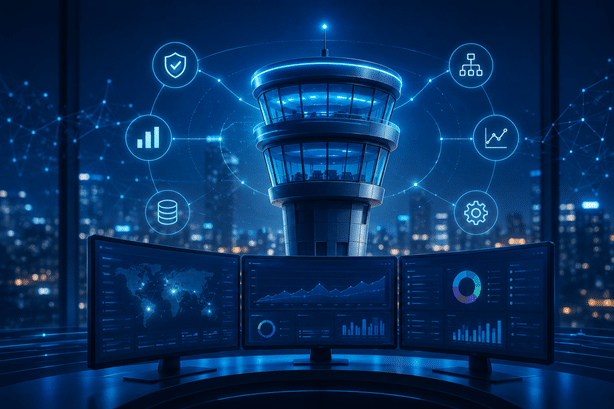
As enterprise AI environments continue to grow, many organizations are looking for better ways to manage visibility, governance, workflows, and operational coordination across increasingly complex systems.
That’s where AI control towers come in.
In this post, we’ll explain what AI control towers are, how they work, common enterprise use cases, and how organizations are using them to better manage AI operations at scale.
What Is an AI Control Tower?
An AI control tower is a centralized platform used to monitor, govern, and coordinate enterprise AI operations.
As organizations scale AI across teams and systems, operations can quickly become fragmented, making visibility and coordination more difficult.
These platforms help organizations centralize visibility, orchestration, governance, and operational intelligence across the AI ecosystem. Instead of relying on disconnected dashboards and manual coordination, organizations can manage AI operations more efficiently from a single operational view.

Why AI Control Towers Are Emerging
As enterprises scale AI across teams, tools, and environments, operations become harder to manage.
A few key challenges are driving the rise of AI control towers.
1. Growing AI Complexity
AI operations often outgrow the processes used to manage them. Different teams may adopt different tools, workflows, and governance standards, leading to fragmented operations and disconnected visibility.
2. Operational and Governance Challenges
Many organizations struggle with siloed monitoring tools, inconsistent governance policies, limited operational visibility, and growing compliance requirements.
3. Increasing Need for Centralized Oversight
As AI adoption grows, organizations need better ways to monitor, govern, and coordinate operations at scale. This centralized approach helps enterprises improve visibility, orchestration, and governance across AI operations.
What Problems Does an AI Control Tower Solve?
As enterprises scale AI initiatives, operations often become fragmented across teams, tools, environments, and workflows. As a result, organizations can struggle to maintain visibility, governance, and operational coordination.
1. Limited Visibility Across AI Operations
In many organizations, AI systems are monitored through disconnected dashboards and siloed tools. This makes it difficult for teams to maintain a centralized view of environments, dependencies, workflows, and operational health.
Centralized operational intelligence helps improve visibility across the AI ecosystem.
2. Siloed Governance and Compliance Processes
Different teams often adopt their own governance standards, approval workflows, and compliance processes, creating inconsistencies and operational risk.
These platforms help standardize governance policies, reporting, approvals, and operational controls across teams and systems.
3. Operational Coordination Challenges
AI delivery frequently requires coordination across development, testing, operations, governance, and infrastructure teams. However, manual coordination can slow delivery and create bottlenecks.
Centralized orchestration helps improve coordination and operational efficiency.
4. Increasing Infrastructure Complexity
As AI environments grow, dependencies across pipelines, cloud services, testing environments, and infrastructure become harder to manage.
Centralized visibility and dependency mapping help simplify this operational complexity.

How an AI Control Tower Works
These platforms centralize operational data across enterprise AI environments to improve visibility, governance, orchestration, and analytics.
While every organization is different, most include several core capabilities.
1. Data and Telemetry Collection
These platforms collect operational data from across the enterprise, including AI pipelines, cloud platforms, DevOps systems, testing environments, monitoring tools, and governance platforms.
By centralizing this information, organizations can create a clearer view of their AI operations.
2. Centralized Visibility and Monitoring
Once data is collected, the AI control tower provides centralized dashboards that help teams monitor system health, workflows, dependencies, incidents, and operational risks.
3. Governance and Compliance Management
They also help standardize governance policies, approvals, audit processes, and compliance monitoring across enterprise AI operations.
As AI environments grow, centralized governance becomes increasingly important for maintaining consistency and reducing risk.
4. Workflow Orchestration and Automation
Many AI control towers include orchestration and automation features that help coordinate workflows across teams, systems, and environments.
This may include automating approvals, release coordination, reporting, environment management, and operational workflows.
5. Analytics and Optimization
They also provide analytics that help organizations identify bottlenecks, inefficiencies, risks, and optimization opportunities.
Over time, these insights help enterprises improve operational performance and scale AI delivery more effectively.
AI Control Tower Architecture
Most AI control towers use a layered structure built around visibility, governance, orchestration, analytics, and integrations.
Together, these layers help organizations centralize monitoring, coordinate workflows, standardize governance, and connect AI operations across enterprise systems and environments.
Key Components of an AI Control Tower
These platforms combine several capabilities that help organizations manage AI operations more efficiently.
1. Operational Dashboards
Centralized dashboards give teams real-time visibility into AI workflows, environments, dependencies, and operational health. This helps teams identify issues faster and improve coordination.
2. Workflow Orchestration
Workflow orchestration helps coordinate processes across AI pipelines, testing environments, release workflows, and operational systems, reducing manual coordination effort.
3. Dependency Mapping
AI environments often include interconnected systems, pipelines, infrastructure, and data sources. Dependency mapping helps teams better understand these relationships and identify operational risks.
4. Monitoring and Observability
AI control towers provide centralized monitoring that helps teams track system performance, workflow activity, incidents, and operational health.
5. Governance and Compliance Controls
Governance capabilities help organizations standardize policies, approvals, audit processes, and compliance monitoring across AI operations.
6. Automation Engines
Automation features help streamline repetitive operational tasks such as approvals, reporting, workflow routing, and provisioning activities.
AI Control Tower Vs Related Technologies
The term “AI control tower” is often used alongside other enterprise AI and operations technologies. While there’s some overlap, they serve different purposes.
1. AI Control Tower Vs AIOps
AIOps focuses on using AI to automate IT operations and incident management. AI control towers are broader platforms designed to improve visibility, governance, orchestration, and coordination across enterprise AI operations.
2. AI Control Tower Vs AI Governance Platforms
AI governance platforms primarily focus on compliance, policies, ethics, and model accountability. AI control towers include governance capabilities but also help manage workflows, operations, environments, and enterprise coordination.
3. AI Control Tower Vs Traditional Monitoring Tools
Traditional monitoring tools mainly track infrastructure health, logs, uptime, and application performance. AI control towers provide a wider operational view that includes governance, dependencies, orchestration, workflows, and operational oversight.
Common Enterprise AI Control Tower Use Cases
These platforms can support a wide range of enterprise AI and operational workflows:
1. Enterprise AI Governance
Many organizations use these platforms to centralize governance policies, approvals, compliance reporting, and operational oversight across AI initiatives.
2. AI Release Coordination
AI delivery often involves multiple teams, testing workflows, deployment pipelines, and approval processes. AI control towers help improve coordination across these release activities.
3. Test Environment Visibility
AI systems often rely on complex testing environments and interconnected infrastructure. AI control towers help teams better track environment availability, dependencies, utilization, and operational risks.
4. Cross-Team Operational Coordination
Many enterprises struggle with siloed workflows between DevOps, testing, operations, and governance teams. These platforms help centralize coordination and improve collaboration across the delivery process.
How To Implement an AI Control Tower
Implementing an AI control tower involves more than adding another platform. Organizations also need clear governance, operational visibility, and standardized workflows.
1. Define Operational Goals
Start by identifying the biggest operational challenges you want to solve, whether that’s improving visibility, strengthening governance, reducing manual coordination, or streamlining AI delivery.
2. Identify Systems and Dependencies
Map the AI systems, environments, workflows, and infrastructure dependencies involved across the delivery process. Clear dependency visibility is essential for effective coordination.
3. Centralize Visibility
Bring monitoring, reporting, and operational intelligence into a centralized view so teams can better track AI operations across environments and systems.
4. Standardize Governance and Workflows
Establish consistent governance policies, approval processes, reporting standards, and operational workflows across teams to improve scalability and reduce fragmentation.
5. Automate Repetitive Processes
Focus automation efforts on repetitive operational tasks like approvals, reporting, monitoring, and workflow coordination to improve efficiency and reduce manual overhead.
The Future of AI Control Towers
As enterprise AI environments continue to grow, AI control towers will likely become even more important for managing operational complexity at scale.
In the future, many organizations will move beyond basic monitoring and governance toward more intelligent and automated operations. These platforms may increasingly support predictive insights, automated workflow orchestration, AI-driven risk detection, and real-time operational optimization across enterprise systems.
At the same time, growing compliance requirements and expanding AI ecosystems will push organizations to centralize visibility and coordination even further.
As AI adoption continues to accelerate, enterprises will need better ways to manage governance, workflows, environments, and operational intelligence across increasingly connected systems. These platforms are positioned to become an important part of that operational foundation.
Final Thoughts
As AI adoption grows, managing AI operations across teams, systems, and environments becomes much more challenging. AI control towers help organizations centralize visibility, governance, orchestration, and operational coordination so teams can scale AI more effectively.
For enterprises managing complex delivery ecosystems, centralized operational intelligence is becoming increasingly important for maintaining visibility and control at scale.
Enov8 helps enterprises simplify complex operations through integrated solutions for environment management, release management, test data management, and enterprise operational visibility. If you’re looking to improve coordination and visibility across enterprise delivery workflows, Enov8 can help.
