
IT Environment Management
Manage complex non production environments as a governed delivery asset, not a collection of spreadsheets, tickets and team knowledge.
The Enterprise Problem
Enterprise software delivery depends on non production environments, but those environments are often poorly understood, manually managed and heavily contested.
Teams lose time because environments are unavailable, unstable, misconfigured, over booked, out of sync, or missing the data and integrations needed for meaningful testing.
The result is delayed testing, missed release windows, higher operational cost and avoidable production risk.
What Is IT Environment Management?
IT Environment Management is the discipline of managing the availability, configuration, usage, readiness and governance of non production environments across the software delivery lifecycle.
It gives delivery, testing, release, infrastructure, application and data teams a shared view of the environments they depend on, including who owns them, how they are configured, what versions they contain, what data they use, and when they are required.
At enterprise scale, IT Environment Management becomes a control point for coordinating demand, reducing contention, improving release readiness and ensuring environments are fit for purpose before critical delivery activity begins.
Why IT Environment Management Matters
IT Environment Management matters because it turns environment activity into enterprise control.
Without effective environment management, organisations struggle to understand environment availability, stability, configuration, ownership, usage, data readiness and deployment status. This creates delivery delays, failed testing, release conflicts, environment contention, avoidable escalation and greater dependency on manual coordination.
With IT Environment Management, organisations can plan delivery with greater confidence, coordinate shared non production resources, improve release and test readiness, reduce environment waste and provide clearer visibility across the software delivery lifecycle.
| Capability | What it provides |
|---|---|
| Environment portfolio visibility | A structured view of non production environments, systems, ownership, usage, status and lifecycle across the enterprise estate. |
| Environment demand management | A controlled way to capture, assess and coordinate environment demand from projects, releases, testing teams and platform teams. |
| Environment booking and allocation | Visibility of who is using each environment, when it is required, what it is being used for and where conflicts may occur. |
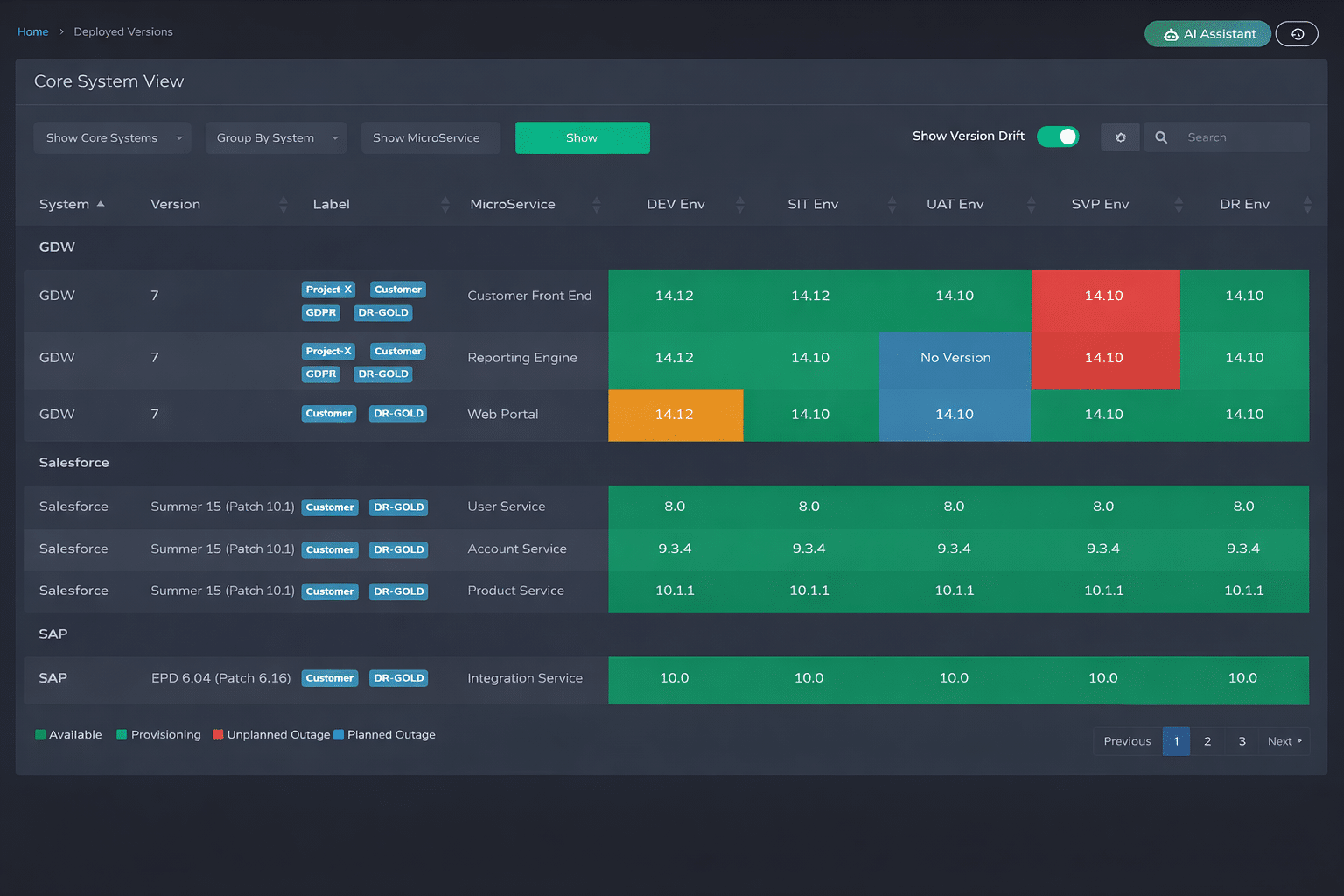
| Configuration and version awareness | Insight into deployed versions, environment configuration, system dependencies and readiness across shared test environments. |
| Environment health and availability tracking | Visibility of environment stability, incidents, outages, defects, constraints and operational status that may impact delivery. |
| Test data readiness alignment | Connection between environment planning and the data required for development, testing, UAT, rehearsal and release validation. |
| Environment lifecycle governance | Control over environment creation, usage, refresh, retirement, cost, ownership and compliance across the non production estate. |
| Dashboards and reporting | Executive and operational visibility of environment status, demand, risk, contention, readiness, utilisation and delivery confidence. |
IT Environment Management Solution Capabilities
IT Environment Management gives organisations a governed, connected and delivery aware view of their non production environment landscape, supporting better decisions across testing, release, platform, data and operations teams.
| Capability | Outcome |
|---|---|
| Governed environment inventory | A trusted source of truth for environments, systems, instances, owners, usage, status and relationships. |
| Ownership and accountability | Clear responsibility for environment support, readiness, lifecycle, access and operational decisions. |
| Demand and booking coordination | Visibility of environment demand, reservations, conflicts and contention across projects, releases and test teams. |
| Readiness and availability insight | Confidence that environments are available, configured, stable and fit for planned delivery activity. |
| Dependency and impact awareness | Understanding of how integrations, shared services and environment relationships affect testing, releases and change. |
| Deployment and version visibility | Visibility of what has been deployed where, which versions are in use and whether environments align to release needs. |
| Operational control | Repeatable management of incidents, requests, changes, refreshes, shakedowns, outages and support activity. |
| Cost and utilisation insight | Clear visibility of idle, duplicated, over provisioned and under used environments to support rationalisation and cost control. |
Common IT Environment Management Use Cases
Large delivery organisations need more than environment records. They need a way to coordinate demand, prove readiness, manage operational activity and understand how environment issues affect releases, testing, data and cost.
Enov8 supports the core use cases required to control shared non production estates at enterprise scale.
| Use case | Traditional approach | Enov8 approach |
|---|---|---|
| Environment inventory and visibility | Environment information is held in spreadsheets, static registers, CMDB records or team knowledge. | Maintain a live, delivery aware view of systems, environments, components, interfaces, owners, usage and relationships. |
| Environment booking and contention | Teams reserve environments through emails, meetings, shared calendars or informal coordination. | Coordinate environment demand through controlled booking, forward planning and conflict visibility across projects, releases and teams. |
| Release environment readiness | Readiness is checked late through manual status calls, spreadsheets and fragmented updates. | Assess whether required environments, versions, data, integrations and dependencies are ready before release activity begins. |
| Environment drift management | Version and configuration differences are discovered manually, often after testing fails or defects are raised. | Track deployed versions, configuration alignment and lifecycle differences across development, test, UAT and pre production. |
| Environment provisioning and refresh | Provisioning and refresh activity depends on manual tickets, specialist teams and inconsistent scripts. | Standardise and govern provisioning, shakedown, refresh and decommission processes through repeatable orchestration patterns. |
| Environment incident and request management | Environment issues are managed across disconnected ITSM tickets, emails and support channels. | Manage environment related incidents, requests, changes and support activity in the context of affected systems, releases and teams. |
| Cost and utilisation management | Idle, duplicated or over provisioned environments are difficult to identify and often remain active unnecessarily. | Expose environment usage, ownership, lifecycle state and utilisation to reduce waste and support better cost control. |
| Enterprise release coordination | Release teams rely on separate updates from application, infrastructure, testing and environment teams. | Connect environment availability, readiness, deployment status and dependencies directly to enterprise release planning and execution. |
How Enov8 Is Different
Enov8 does not treat environment management as a spreadsheet, ticket queue or standalone inventory.
It treats environments as a core control point for enterprise software delivery.
That means environment knowledge can be used to improve release planning, test execution, data coordination, deployment governance, cost control and operational decision making.
| Difference | Why it matters |
|---|---|
| Delivery aware environment model | Environments are connected to systems, releases, projects, data, deployments and teams. |
| Built for enterprise complexity | Supports large, hybrid, multi system landscapes with shared environments and competing delivery demand. |
| Planning and governance together | Combines environment booking, demand management, readiness checks and operational control. |
| Automation ready | Supports standardised orchestration for provisioning, refresh, validation, shakedown and decommission. |
| Connected to release and data management | Environments are managed in context, not isolated from the release and test data lifecycle. |
| Financially measurable | Helps expose environment sprawl, idle capacity, licence waste and avoidable operational cost. |
Powered by Enov8 Environment Manager
The IT Environment Management solution is powered by Enov8 Environment Manager, part of the broader Enov8 platform for Environment, Release and Data Management.
Environment Manager provides the operational foundation for managing non production environments across complex enterprise landscapes, including inventory, booking, demand planning, readiness, deployment visibility, service management, automation and reporting.
When combined with Enov8 Release Manager and Enov8 Test Data Management, organisations can connect environment control directly to release governance and data readiness, creating a more complete control tower for enterprise software delivery.
This is close to what you already have, but avoids repeating the solution name as if it is the product name.
Related Solutions
Explore related Enov8 solutions that connect Applications, Environments, Release and Data across your landscape.
IT Environment Management FAQs
What is IT Environment Management?
IT Environment Management is the practice of managing the availability, configuration, usage, readiness and governance of non production environments used for development, testing, release and support.
Why is IT Environment Management important?
It helps organisations reduce environment contention, improve release readiness, avoid testing delays, control infrastructure waste and reduce delivery risk across complex IT landscapes.
What types of environments does Enov8 manage?
Enov8 can manage development, system test, integration test, UAT, pre production, training, support and other non production environments across hybrid and enterprise technology estates.
How does Enov8 reduce environment contention?
Enov8 provides booking, demand management and planning capabilities so teams can see who needs which environments, when they are required and where conflicts exist before they disrupt delivery.
Can Enov8 help with release readiness?
Yes. Enov8 connects environment availability, deployed versions, test data, dependencies and operational status to release planning, helping teams understand whether environments are ready for critical release activity.
Does Enov8 support automation?
Yes. Enov8 can orchestrate and govern environment related automation such as provisioning, refresh, validation, health checks, shakedown and decommission activities.
How is Enov8 different from a CMDB?
A CMDB typically records configuration items. Enov8 extends this by managing environment demand, bookings, readiness, deployments, operational activity, automation and delivery context across the software lifecycle.
How is Enov8 different from a monitoring tool?
Monitoring tools show technical health signals. Enov8 focuses on environment governance, planning, coordination, readiness and delivery impact. It can use monitoring data, but it is not limited to monitoring.
Bring Control to Your Non Production Environments
IT environments are too important to be managed through spreadsheets, disconnected tickets and informal team knowledge.
Enov8 gives enterprises the visibility, governance and coordination needed to manage environments as a strategic delivery asset, improving release confidence, reducing waste and helping teams deliver with fewer avoidable delays.