
Enterprise Release Management
Coordinate complex enterprise releases with visibility, governance and control.
The Enterprise Problem
Enterprise releases are difficult to manage when scope, systems, environments, dependencies, deployment activities and stakeholder updates are spread across disconnected tools and teams.
Release managers often rely on spreadsheets, meetings, emails, status packs and manual updates to understand whether a release is on track, what systems are impacted, which environments are required, and whether teams are ready for implementation.
The result is poor visibility, late risk discovery, missed dependencies, deployment confusion, release delays and avoidable production impact.
What Is Enterprise Release Management?
Enterprise Release Management is the discipline of planning, coordinating, governing and tracking software and technology releases across multiple projects, systems, teams and environments.
It provides a structured way to define release scope, align contributing projects, manage milestones, coordinate environment and deployment needs, track readiness, and govern implementation activity through to production.
At enterprise scale, Release Management becomes a control point for connecting business change, delivery execution, environment readiness, deployment planning and operational governance.
Why Enterprise Release Management Matters
Enterprise Release Management matters because it turns release activity into enterprise control.
Without effective release management, organisations struggle to coordinate delivery across projects, systems, environments, data, deployments and teams. This creates poor visibility, release contention, readiness gaps, implementation risk and greater dependency on manual coordination.
With Enterprise Release Management, organisations can plan releases with greater confidence, manage dependencies earlier, improve implementation control, reduce delivery risk and provide clearer visibility across the software delivery lifecycle.
| Capability | What it provides |
|---|---|
| Release portfolio planning | A structured view of enterprise, divisional, agile, infrastructure and project releases across the delivery calendar. |
| Release scope management | A controlled way to define release objectives, contributing projects, impacted systems, work items and delivery dependencies. |
| Milestone and gate tracking | Visibility of key checkpoints, readiness criteria, approvals, risks and progress across the release lifecycle. |
| Environment demand alignment | Connection between release plans and the environments required for build, test, UAT, rehearsal and implementation activity. |
| Deployment and implementation planning | Structured implementation plans, task sequencing, ownership, timing, dependencies, rollback steps and execution status. |
| Release readiness management | Checks that scope, systems, environments, data, teams, defects, approvals and operational activities are ready before go live. |
| Release dashboards and reporting | Executive and operational visibility of release status, risk, progress, readiness, system impact and delivery confidence. |
| Automation and toolchain integration | Integration with DevOps, deployment, ITSM and environment tools to support governed release execution and evidence capture. |
Release Management Solution Capabilities
Release Management gives organisations a governed, connected and delivery aware view of release activity, supporting better decisions across projects, platforms, environments, deployments, data and business readiness.
| Capability | Outcome |
|---|---|
| Governed release inventory | A trusted source of truth for releases, milestones, scope, ownership, status, dependencies and delivery timelines. |
| Release ownership and accountability | Clear responsibility for release planning, coordination, governance, readiness, approvals and implementation decisions. |
| Project and platform alignment | Visibility of which projects, systems, platforms, teams and change activities contribute to each enterprise release. |
| Environment and data coordination | Better alignment between release plans, environment availability, test data readiness, deployment windows and validation activity. |
| Dependency and impact awareness | Understanding of cross project, cross platform and upstream or downstream dependencies that may affect release risk or timing. |
| Deployment and implementation visibility | Visibility of planned and completed deployments, implementation tasks, release events, cutover activities and execution status. |
| Readiness and governance control | Structured readiness checks, approvals, evidence capture and decision support before releases move into critical stages. |
| Release reporting and assurance | Clear reporting on release progress, risk, conflicts, readiness, delays and outcomes to support enterprise delivery governance. |
Common Enterprise Release Management Use Cases
Enov8 supports the core release management scenarios that large delivery organisations need to coordinate complex change across systems, teams and environments.
| Use case | Traditional approach | Enov8 approach |
|---|---|---|
| Enterprise release calendar | Release dates are tracked in spreadsheets, shared calendars or separate project plans. | Maintain a central release calendar that shows enterprise, divisional, agile, infrastructure and project releases in one governed view. |
| Release scope and impact | Scope, impacted systems and contributing projects are gathered manually from project teams. | Define release scope, impacted systems, contributing projects, work items and dependencies in a structured release model. |
| Milestone and gate governance | Milestones and approvals are managed through meetings, emails and manual status reporting. | Track release milestones, gates, readiness checkpoints, risks and approvals across the release lifecycle. |
| Environment and data readiness | Environment and data needs are discovered late, often during test planning or release readiness calls. | Connect release plans to required environments, bookings, versions, data needs and readiness status. |
| Implementation planning | Deployment day plans are maintained in documents, spreadsheets or disconnected runbooks. | Manage implementation tasks, sequencing, ownership, timing, dependencies, rollback steps and execution status centrally. |
| Release risk and dependency management | Risks and dependencies are identified through manual updates and may be missed until late in the cycle. | Expose release risks, system dependencies, environment conflicts and delivery blockers early enough to act. |
| Executive release reporting | Status packs are manually assembled from multiple project and delivery sources. | Provide real time release dashboards showing status, progress, risk, readiness, system impact and delivery confidence. |
| DevOps and deployment governance | CI/CD tools execute deployments, but enterprise release context and evidence are often fragmented. | Connect DevOps execution to enterprise release governance, deployment evidence, environment status and release traceability. |
How Enov8 Is Different
Enov8 does not treat release management as a project status report, deployment checklist or isolated DevOps pipeline.
It treats releases as a core control point for enterprise software delivery.
That means release knowledge can be used to improve planning, dependency management, environment coordination, deployment governance, operational readiness and executive decision making.
| Difference | Why it matters |
|---|---|
| Enterprise release model | Releases are connected to projects, systems, environments, data, deployments, milestones and teams. |
| Built for complex change | Supports enterprise, divisional, agile, infrastructure and project release patterns across large delivery landscapes. |
| Planning and execution together | Combines release planning, readiness, implementation sequencing, deployment status and operational governance. |
| Environment aware | Connects release activity to environment availability, bookings, deployed versions, test phases and readiness checks. |
| Toolchain friendly | Works alongside DevOps, CI/CD, ITSM and deployment tools rather than forcing teams to replace their existing execution platforms. |
| Governance with evidence | Captures release decisions, readiness status, deployment activity and operational evidence for auditability and improvement. |
Powered by Enov8 Release Manager
The Enov8 Enterprise Release Management solution is powered by Enov8 Release Manager, part of the broader Enov8 platform for Environment, Release and Data Management.
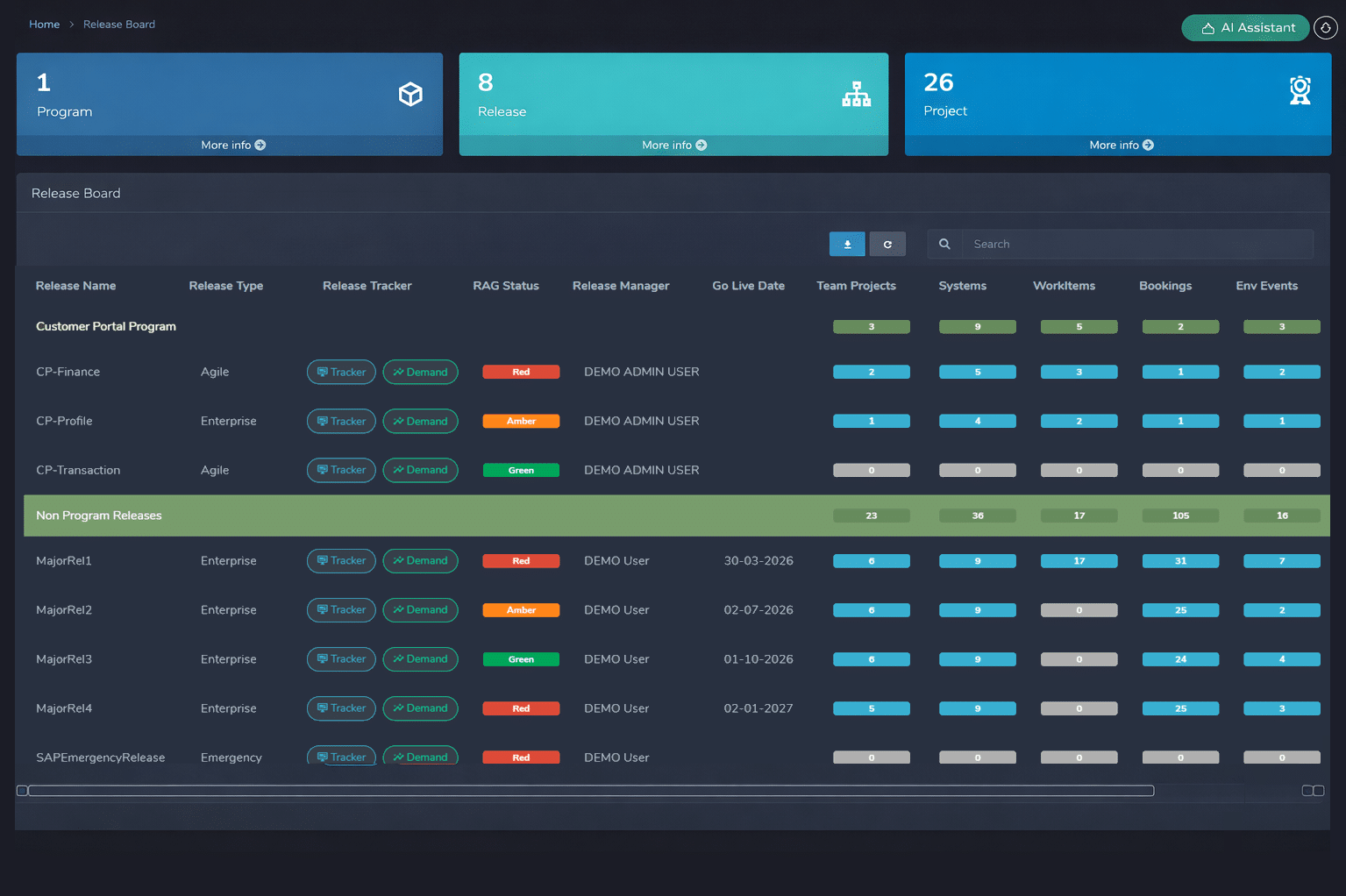
Release Manager provides the operational foundation for planning, governing and coordinating releases across complex enterprise landscapes. It supports release calendars, scope management, project alignment, milestone tracking, environment demand, implementation planning, readiness, dashboards and reporting.
When combined with Enov8 Environment Manager and Enov8 Test Data Management, organisations can connect release governance directly to environment readiness and data availability, creating a more complete control tower for enterprise software delivery.
Related Solutions
Explore related Enov8 solutions that connect Applications, Environments, Release and Data across your landscape.
Enterprise Release Management FAQs
What is Enterprise Release Management?
Enterprise Release Management is the practice of planning, coordinating, governing and tracking releases across multiple projects, systems, teams and environments.
Why is Enterprise Release Management important?
It helps organisations coordinate complex change, reduce release risk, improve readiness, manage dependencies and provide stakeholders with a clear view of release status and confidence.
How is Enterprise Release Management different from deployment automation?
Deployment automation focuses on executing technical deployment steps. Enterprise Release Management governs the broader release context, including scope, dependencies, environments, readiness, approvals, implementation planning and stakeholder reporting.
Can Enov8 support agile release trains?
Yes. Enov8 can support agile release trains, program increments, enterprise releases, divisional releases, infrastructure releases and project based release models.
How does Enov8 help with release readiness?
Enov8 connects release scope, impacted systems, milestones, environments, deployed versions, data needs, defects, risks and approvals to provide a clearer view of readiness before go live.
Does Enov8 replace CI/CD tools?
No. Enov8 works alongside CI/CD and DevOps tools. It provides enterprise governance, visibility, coordination and evidence across release activity, while existing tools continue to perform build and deployment execution.
Can Enov8 help with implementation planning?
Yes. Enov8 supports implementation planning by capturing tasks, sequencing, ownership, timing, dependencies, rollback steps and execution status for deployment windows.
How is Enov8 different from project management tools?
Project management tools track project activity. Enov8 connects release activity to systems, environments, deployment plans, readiness, risks, dependencies and operational governance across the enterprise delivery lifecycle.
Bring Control to Enterprise Releases
Enterprise releases are too important to be managed through disconnected spreadsheets, status packs and informal coordination.
Enov8 gives organisations the visibility, governance and coordination needed to manage releases as a strategic delivery control point, improving confidence, reducing risk and helping teams deliver change with fewer avoidable disruptions.