

Product lifecycle management (PLM) plays a critical role in ensuring the longevity and competitiveness of software products. A successful software solution is not an accident, but rather a result of ongoing supply chain management, maintenance and a clear long-term vision.
An excellent example of this is Apple’s Mac OS, which, despite its launch in 1984, continues to be a widely used operating system through effective product management practices.
Much of that lasting success comes from Apple’s effective use of Product Lifecycle Management.
PLM is the critical process of continuously analyzing and supporting software, and its importance cannot be overstated. In this article, we explore why PLM matters and why you should consider it for future projects.
History of PLM
The history of PLM goes back to the mid-20th century. At that time, manufacturers began looking for better ways to manage their products and related data.
One of the earliest forms of PLM was computer-aided design (CAD). Engineers developed it in the 1950s and 1960s to create, manage, and share designs more effectively. As computers and software grew more powerful, PLM expanded. It came to cover product data management, simulation, analysis, and collaboration.
Interest in PLM surged in the 1990s. Organizations saw the benefits of managing product data and processes in a more integrated way. During this period, many PLM solutions were developed and commercialized, and the term “Product Lifecycle Management” was widely adopted.
Today, most organizations see PLM as a critical part of product development. Companies in automotive, aerospace, consumer goods, and many other industries use it.
As digital transformation grows, PLM has become even more important. It helps organizations stay ahead on innovation and competitiveness.

What Is Product Lifecycle Management and What Are Its Stages
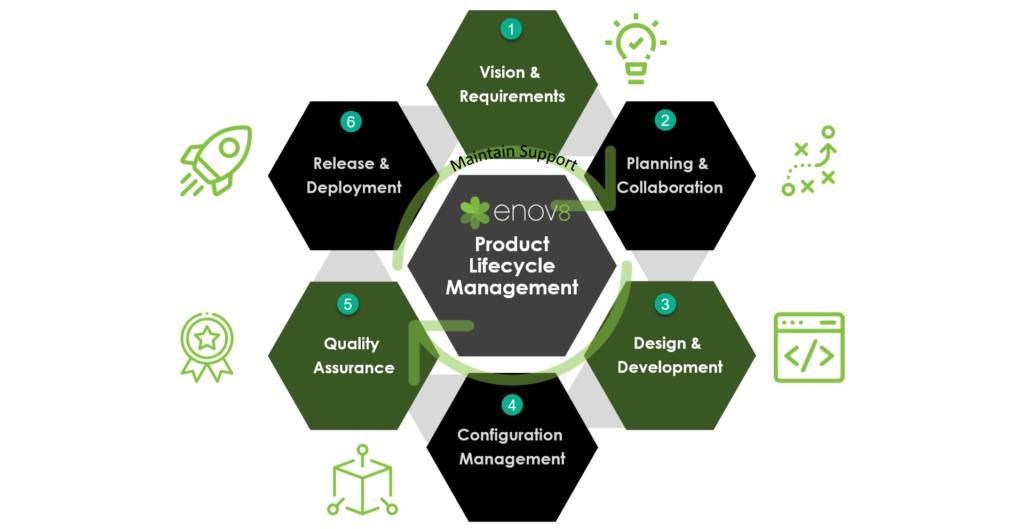
Whether its global manufacturers or startups, In the context of software engineering, the 7 core tasks, or phases, of Product Lifecycle Management would include the following.
1. Product Requirements Management
This involves gathering, analyzing and managing the requirements for software products throughout their lifecycle. As a result, the product meets the needs of the customer and the market.
Requirements management defines the product’s scope, objectives, and features. It then tracks those requirements throughout development to confirm the team meets them.
2. Planning, Collaboration and Communication
In order to deliver a successful product, it is crucial that development teams and stakeholders collaborate and communicate effectively. This includes tasks such as project planning, resource allocation, and risk management. Effective collaboration and communication can help to reduce development time, minimize risks, and improve the quality of the end product.
3. System Design and Development
This involves creating software designs, coding, and testing software products to ensure they meet customer needs. The design process defines the product architecture and selects the right technologies. It also makes sure the product can scale and stay maintainable.
Development involves coding and testing the product to ensure that it meets the requirements and is functional.

4. System Configuration Management
This involves tracking and managing changes to software artifacts throughout the product lifecycle to ensure quality and consistency. Configuration management keeps the product under version control, so teams can track changes and roll them back if needed.
This helps to maintain the quality of the product and to minimize the risk of errors and bugs.
5. Quality Assurance and Testing
This involves verifying the quality and functionality of software products to ensure they meet customer expectations. Quality assurance and testing includes tasks such as unit testing, integration testing, and regression testing. Quality assurance and testing aim to find and fix issues before customers receive the product.
6. Product Release and Deployment
This involves planning and executing the release of software products to customers and users in a timely manner. Release and deployment involves tasks such as version control, release management, and change management. The release process should run smoothly, so customers get the latest version with minimal downtime.
7. Product Maintenance and Support
This involves providing ongoing maintenance and support for software products to ensure their continued success. Maintenance and support include tasks such as bug fixing, performance optimization, and security updates.
Maintenance and support keep the product up to date and working over time. They also give customers the help they need to succeed.
What Is Software PLM?
Software PLM refers to the use of software tools to manage the entire lifecycle of a product from ideation to retirement. Software PLM aims to make product development more efficient and coordinated. To do this, it brings all product data, processes, and stakeholders together.
Typically, software PLM solutions provide tools for product data management, product design and engineering, collaboration and communication, and business analysis. Teams use these tools to manage product data and processes, such as requirements, design specs, testing, manufacturing, and maintenance.
Software PLM helps organizations streamline development and reduce rework. It also improves quality, speeds time to market, and boosts collaboration. Industries such as automotive, aerospace, consumer goods, and high-tech electronics use it widely.
Common Software PLM Use Cases
Many industries use Product Lifecycle Management (PLM) software to manage products from conception to retirement. Here are some common use cases for PLM software.
- Product Design and Development: PLM software helps manage the product design process, from idea creation to engineering and prototyping, to ensure efficient and effective product development.
- Bill of Materials (BOM) Management: PLM software helps manage the BOM, including all the components and sub-assemblies required to build a product, and tracks changes to the BOM throughout the product lifecycle.
- Change Management: PLM software provides a centralized repository for managing and tracking changes to product specifications, designs, and documentation.
- Collaboration and Communication: PLM software enables cross-functional teams to collaborate on product development and design, facilitating communication and reducing errors and delays.
- Quality Management: PLM software helps organizations manage product quality and compliance, including testing and inspection processes, to ensure that products meet industry and customer requirements.
- Supplier Management: PLM software enables organizations to manage relationships with suppliers, track supplier performance, and ensure the timely delivery of components and sub-assemblies.
- Document Management: PLM software provides a centralized repository for storing and organizing product-related documents, including design drawings, specifications, and test reports.
- Sustainability and Environmental Compliance: PLM software helps organizations manage sustainability and environmental impact throughout the product lifecycle, including material selection and end-of-life product disposal.
What Benefits Does Software PLM Offer?
The top 8 benefits of product lifecycle management, or implementing a PLM System, are:
- Improved Product Development: PLM systems helps streamline the product’s lifecycle development process, reducing time-to-market, delivering competitive advantage and ensuring that products meet customer requirements and business goals.
- Increased Collaboration: PLM facilitates collaboration and communication among development teams, stakeholders, steering committees, and customers, leading to improved decision-making and product outcomes.
- Better Data Management: Product Data Management provides a centralized repository for product data, improving data accuracy, accessibility, and consistency.
- Enhanced Product Quality: PLM solutions integrate quality assurance and testing into the product development process, helping to identify and resolve product issues early in the lifecycle.
- Reduce Complexity: Software architecture can become complex over time. PLM helps reduce complexity, across the product value chain, by tracking, reporting, and communicating changes throughout each iteration. This increases visibility and makes it easier to troubleshoot errors and maintain stability.
- Mitigate Risk: Product Lifecycle Management helps identify issues in advance, allowing teams to prioritize security and catch vulnerabilities before they affect performance.
- Decrease Technical Debt: Technical debt can cause costly reworks and even discontinuation of a product. PLM helps teams avoid potential technical debt and maintain lean, efficient software.
- Reduced Costs: By improving efficiency, reducing rework, and minimizing errors, PLM helps reduce development costs and increase profitability.
Top 5 Software Lifecycle PLM Challenges
The top 5 challenges to successful implementation of Product Lifecycle Management (PLM) are:
- Change Management: Implementing PLM requires significant changes to organizational processes and culture, which can be difficult to manage and may require strong leadership and effective communication.
- User Adoption: Ensuring widespread user adoption and engagement is crucial for the success of PLM initiatives, as PLM systems can only be effective if they are used consistently and correctly. This may require significant training and support to overcome resistance to change.
- Lack of Ownership: Without a system in place for assigning ownership and governing product collaboration, it’s difficult to maintain a consistent approach to PLM.
- Unclear Vision: Without a clear product vision, up to date information, or road map, it’s hard to track changes and keep software moving in the right direction.
- Poor Visibility of Data: Without data and insights into product outcomes, it’s difficult to make necessary changes and release updates. Integrating disparate data sources into a centralized PLM system can be complex and require extensive planning and coordination.
Key Considerations when Choosing PLM Software
Here are some important considerations when you’re choosing or implementing PLM software.
1. Understand Your Business Needs
Before selecting a PLM software solution, it is important to understand the specific needs of your business. What processes do you need to manage? What data do you need to track? Which reports do you need?
Answering these questions will help you determine the best PLM software for your organization.
2. Evaluate Your Existing Systems
It is important to evaluate your existing systems and processes before implementing a new PLM software solution. Which existing systems should connect to the new system?
Which manual processes could the new system automate? Understanding how the new system will interact with existing systems and processes will help ensure a smooth transition.
3. Consider Scalability
As your business grows, so too should your PLM software solution. Make sure to select a solution that can scale with your business and accommodate future growth.
4. Think about Security
Security is an important consideration when selecting a PLM software solution. Make sure to select a solution that offers robust security features such as user authentication, data encryption, and access control measures.
5. Cost, Of Course
Cost is always an important factor when selecting any type of software solution. Make sure to evaluate all costs associated with the implementation and maintenance of the system, including licensing fees, training costs, and ongoing support costs.
6. User Experience
The user experience should be a top priority when selecting a PLM software solution. Make sure to select a solution that is easy to use and understand, with intuitive navigation and features that make it easy for users to access the information they need.
PLM Software vs ERM
PLM (Product Lifecycle Management) and ERM (Enterprise Release Management) are both management processes used in organizations, but they have different scopes and objectives.
PLM is a process that helps organizations manage the entire lifecycle of a product, from conception to retirement. It encompasses all aspects of product development and design, including engineering, manufacturing, and quality control. The goal of PLM is to improve the efficiency and effectiveness of product development and ensure that products meet customer and industry requirements.
On the other hand, ERM is a process that helps organizations manage and control the release of software and other applications. ERM focuses on the release process for applications, including planning, testing, deployment, and post-release support. ERM aims to manage software releases in a controlled, consistent way. As a result, it reduces errors and keeps releases aligned with business needs.
In summary, PLM is a broader management process that covers the entire lifecycle of a product, while ERM is a specific management process that focuses on the release of software and other applications.
PLM Software vs ERP
PLM (Product Lifecycle Management) and ERP (Enterprise Resource Planning) are two distinct systems that support different parts of the business.
As explained above, PLM focuses on the product development and design processes, including product planning, design, engineering, manufacturing, and product maintenance. PLM systems help organizations manage product information, collaborate on product development, and track the product lifecycle from conception to retirement.
ERP, on the other hand, is a broader software system that helps organizations manage various business processes, including finance, accounting, human resources, procurement, and supply chain management. ERP systems provide a centralized platform for managing and automating business processes and help organizations make informed decisions based on real-time data and insights.
In summary, PLM and ERP are complementary systems that serve different purposes. While PLM focuses on product development and design, ERP focuses on enterprise-wide business operations.
Many organizations use both PLM and ERP systems to support different aspects of their business operations and improve efficiency and decision-making.
Enov8’s Approach to PLM
Enov8’s suite of platforms support PLM by providing tools for managing software development and product lifecycle processes, such as environment management, release management, and test data management. These help organizations streamline their operations, reduce the risk of errors, and ensure products meet customer and business requirements.
The platforms include:
- Enterprise Release Management (to manage releases trains and there various project & team artifacts),
- IT & Test Environment Management (to control product environments) and
- Test Data Management (for test data profiling & securitization).
In conclusion, Enov8’s suite of platforms is the perfect solution for PLM. It provides a comprehensive set of tools to manage software development processes and product lifecycles from environment management through release control and test data administration.
This ensures that companies are able to execute their operations with greater efficiency, reduce risk levels, and guarantee products meet customer expectations as well as corporate objectives all at once!
Enov8 Case Study: Large Utility Agile Enterprise Releases
A large organization improved their IT operations by using Enov8’s Release Management solution. This solution streamlined the deployment process and reduced the time it took to deploy new releases. As a result, the organization was able to reduce their IT costs by 20%, improve operational efficiency by 30%, and increase customer satisfaction by 40%. Read on.
Post Author
Jane Temov is an IT Environments Evangelist at Enov8, specializing in IT and Test Environment Management, Test Data Management, Data Security, Disaster Recovery, Release Management, Service Resilience, Configuration Management, DevOps, and Infrastructure/Cloud Migration. Jane is passionate about helping organizations optimize their IT environments for maximum efficiency.