
Test Data Management
Deliver safe, realistic and compliant test data on demand.
Deliver realistic, compliant and right sized test data to teams when they need it, while protecting sensitive information, reducing data waste and improving delivery confidence.
The Enterprise Problem
Enterprise delivery depends on high quality test data, but that data is often difficult to access, slow to refresh and risky to use.
Teams wait for database copies, work with stale or incomplete data, duplicate large production data sets, or use sensitive information in non production environments without consistent masking or validation.
The result is delayed testing, higher infrastructure cost, poor release confidence, compliance exposure and increased data security risk.
What Is Test Data Management?
Test Data Management is the discipline of controlling how data is sourced, protected, prepared, delivered and validated for use in non production environments such as development, testing, UAT, training and staging.
It gives delivery, testing, data, security and compliance teams a governed way to discover sensitive data, apply masking rules, create smaller data sets, generate synthetic records, virtualise databases and validate that data is safe before use.
At enterprise scale, Test Data Management becomes a control point for balancing delivery speed, data quality, privacy, compliance and operational efficiency across the software delivery lifecycle.
Why Test Data Management Matters
Test Data Management matters because it turns test data activity into enterprise control.
Without effective test data management, organisations struggle to provide delivery teams with realistic, compliant and right sized data when it is needed. This creates testing delays, data quality issues, privacy exposure, infrastructure waste, release risk and greater dependency on manual data coordination.
With Test Data Management, organisations can provide safer, production like data to development, testing, UAT and release teams with greater confidence, while reducing sensitive data exposure, improving test readiness and controlling data cost across the software delivery lifecycle.
| Capability | What it provides |
|---|---|
| Test data portfolio visibility | A structured view of data sources, ownership, usage, sensitivity, availability and readiness across the non production estate. |
| Data refresh and provisioning coordination | Control over data refresh requests, timing, ownership, dependencies, approvals and delivery status across projects and environments. |
| Environment and release alignment | Connection between test data readiness, environment demand, release plans, testing windows and implementation milestones. |
| Dashboards and reporting | Executive and operational visibility of data readiness, sensitivity, compliance status, demand, risk and delivery confidence. |
Test Data Management Solution Capabilities
Test Data Management gives organisations a controlled way to deliver realistic, compliant and right sized data for development, testing, support, training and release validation.
It brings together data profiling, masking, subsetting, synthetic data generation, database virtualization, compliance validation, environment integration and governance to improve data availability while reducing privacy, security and delivery risk.
| Capability | What it provides |
|---|---|
| Data profiling and discovery | Scans source systems to identify sensitive fields, data structures, relationships and compliance risk before data is used. |
| PII and sensitive data classification | Classifies personal, financial, customer, employee and other sensitive data so protection rules can be applied consistently. |
| Data masking | Applies repeatable, governed masking rules to protect sensitive data while preserving test usefulness and referential integrity. |
| Data subsetting | Creates smaller, targeted and referentially intact data sets to reduce storage, improve refresh speed and support focused testing. |
| Synthetic data generation | Creates realistic artificial data for scenarios, edge cases and test conditions that may not exist in production. |
| Database virtualization | Provides fast, lightweight database copies without repeated full physical duplication across development and test environments. |
| Compliance validation | Validates masking outcomes, checks data protection controls and provides evidence that data is safe for non production use. |
| Environment and release integration | Connects test data delivery to environment bookings, release plans, project timelines and delivery governance. |
Common Test Data Management Use Cases
Enov8 supports the core test data scenarios that large delivery organisations need to provide safe, realistic and compliant data across non production environments.
| Use case | Traditional approach | Enov8 approach |
|---|---|---|
| Protecting sensitive data | Production data is copied into non production environments with inconsistent masking or limited validation. | Profile, classify, mask and validate sensitive data before it is used by development, testing, UAT or support teams. |
| Accelerating data refresh | Teams wait days or weeks for manual database copies, refreshes and approvals. | Provide governed, repeatable data refresh and delivery processes that reduce waiting time and improve delivery flow. |
| Reducing database duplication | Full production databases are repeatedly copied across multiple environments, increasing storage and operational cost. | Use subsetting and database virtualization to provide right sized or lightweight data copies without unnecessary duplication. |
| Improving test quality | Teams test with stale, incomplete or unrealistic data that does not reflect real business scenarios. | Deliver realistic, relevant and targeted data sets that support better functional, integration, regression and UAT outcomes. |
| Supporting compliance and audit | Masking evidence, access controls and compliance checks are documented manually or inconsistently. | Generate repeatable validation evidence showing that sensitive data has been identified, protected and approved for use. |
| Enabling safe data for AI and analytics | Sensitive data may be ingested into AI, analytics or vector store pipelines before adequate protection is applied. | Profile, mask and validate data before ingestion, helping prevent sensitive information from being embedded in downstream AI systems. |
| Providing data on demand | Data requests are handled through tickets, manual coordination and specialist teams. | Give teams self-service virtual database copies in minutes, connected to environment, release and project context so governed data is available when needed. |
| Supporting complex enterprise landscapes | Data management is handled system by system, with limited coordination across applications and delivery teams. | Manage test data across multi system, multi team landscapes with shared governance, visibility and lifecycle control. |
How Enov8 Is Different
Enov8 does not treat Test Data Management as a standalone masking tool or isolated database utility.
It treats test data as a core control point for enterprise software delivery, compliance and operational readiness.
That means data knowledge can be used to improve testing, release planning, environment coordination, compliance validation, infrastructure efficiency and AI data governance.
| Difference | Why it matters |
|---|---|
| Full lifecycle coverage | Covers profiling, discovery, masking, subsetting, synthetic generation, database virtualization, validation and governance across Test Data Manager, DataFactory and VirtualizeMe. |
| Delivery aware data model | Connects test data to systems, environments, releases, projects, teams and delivery timelines. |
| Built in compliance validation | Provides evidence that sensitive data has been identified, protected and validated before non production use. |
| Integrated with environment management | Coordinates data availability with environment bookings, refresh cycles, test windows and readiness checks. |
| Supports AI data protection | Helps organisations profile, mask and validate data before it enters AI, analytics or vector store pipelines. |
| Reduces data and infrastructure waste | Uses subsetting and database virtualization to reduce unnecessary full size database copies and improve refresh speed. |
Powered by Enov8 Data Solutions
Three products, one governed test data lifecycle
Enov8 delivers Test Data Management through three products that work together. Test Data Manager protects the data. DataFactory sizes it and generates it. VirtualizeMe gets it to teams quickly. You can use one product for a specific problem or all three for complete coverage.
Enov8 Test Data Manager
Find, protect and validate sensitive data
Make sure sensitive data is found and protected, with evidence, before it leaves production.
- Profiling and discovery of sensitive data
- PII and sensitive data classification
- Consistent static masking that keeps referential integrity across systems
- Compliance validation and audit evidence
- Data insights and reporting
Enov8 DataFactory
Create the data your tests need
Build small, focused data sets from production, or generate realistic data where production can't help.
- Prune: subsets that keep referential integrity
- Bloom: realistic synthetic data generation
- Coverage for edge cases and scenarios that don't exist in production
- Smaller data footprint and faster provisioning
Enov8 VirtualizeMe (vME)
Deliver data on demand
Give every team its own lightweight database copy in minutes, without duplicating the full database each time.
- Lightweight virtual database copies
- Fast refresh, reset and rollback
- Self-service copies per team, environment or test cycle
- Large cuts to storage and infrastructure cost
How the products cover each use case
Each enterprise test data use case maps to the product that leads on it and the products that support it.
| Use case | Test Data Manager | DataFactory | VirtualizeMe |
|---|---|---|---|
| Protecting sensitive data | |||
| Accelerating data refresh | |||
| Reducing database duplication | |||
| Improving test quality | |||
| Supporting compliance and audit | |||
| Enabling safe data for AI and analytics | |||
| Providing data on demand | |||
| Supporting complex enterprise landscapes |
Part of the Enov8 platform. Combine the Data Solutions with Enov8 Environment Manager and Enov8 Release Manager to link data readiness to environment bookings, refresh cycles and release governance. The result is a single control tower for enterprise software delivery.
Talk to an expert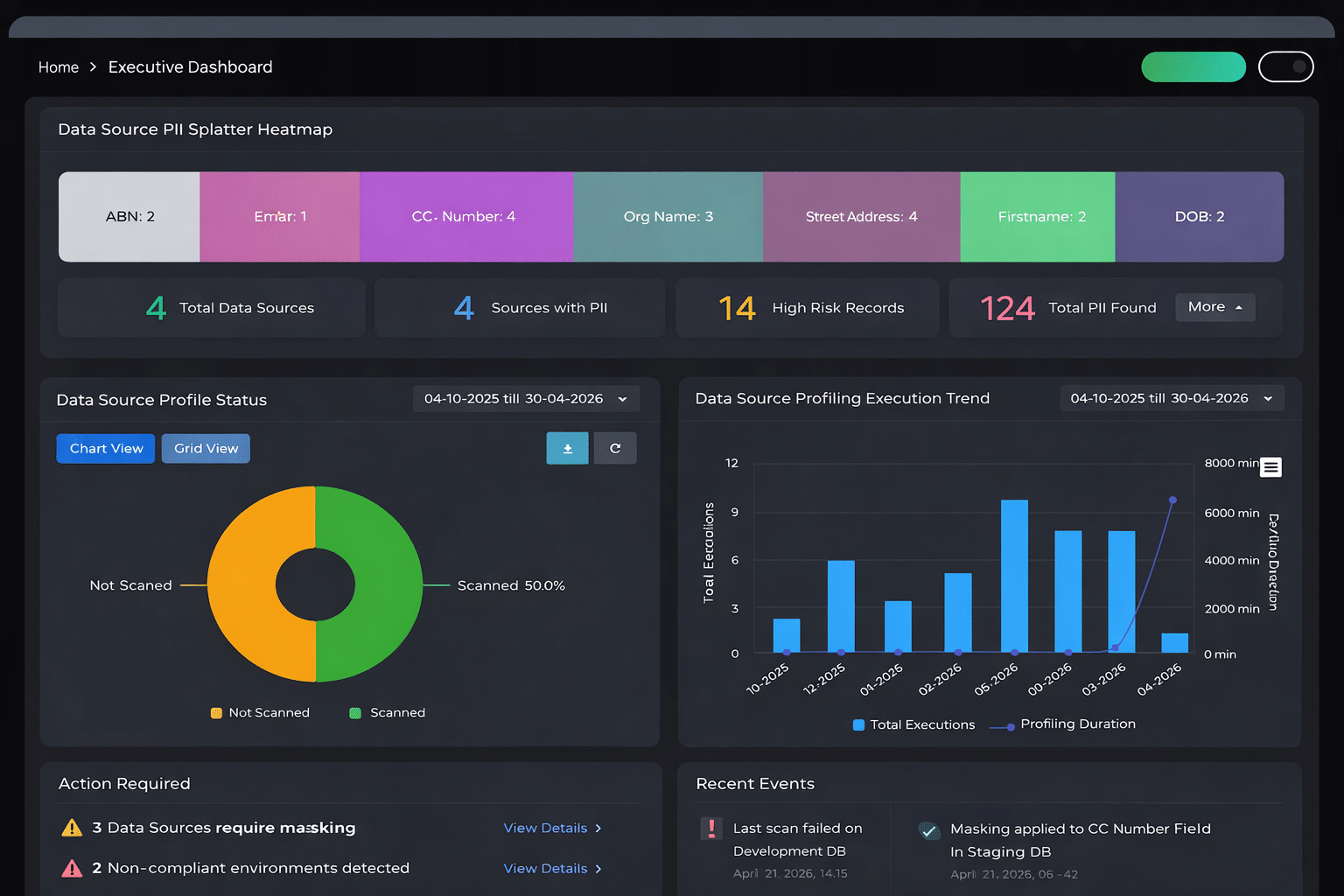
Related Solutions
Explore related Enov8 solutions that connect Applications, Environments, Release and Data across your landscape.
Test Data Management FAQs
What is Test Data Management?
Test Data Management is the practice of sourcing, protecting, preparing, delivering and validating data for use in non production environments such as development, testing, UAT, training and staging.
Why is Test Data Management important?
It helps organisations provide realistic test data quickly while reducing privacy exposure, compliance risk, infrastructure waste and release delays.
What is the difference between data masking and Test Data Management?
Data masking is one part of Test Data Management. A broader TDM capability also includes profiling, sensitive data discovery, subsetting, synthetic data generation, database virtualization, validation, governance and delivery integration.
How does Enov8 reduce data compliance risk?
Enov8 profiles source data, identifies sensitive fields, applies governed masking rules, validates masking outcomes and provides evidence that data is safe for non production use.
How does database virtualization support Test Data Management?
Database virtualization provides fast, lightweight database copies without repeatedly duplicating full physical databases. This helps reduce storage cost, speed up refresh cycles and support data on demand. Enov8 delivers this through VirtualizeMe (vME).
Can Enov8 generate synthetic data?
Yes. Enov8 DataFactory generates realistic synthetic data through its Bloom capability, covering scenarios, edge cases and test conditions that can’t be sourced from production. It can also subset production data with Prune, keeping referential integrity.
How does Test Data Management support DevOps?
Test Data Management supports DevOps by giving teams faster access to safe, relevant and repeatable data sets as part of development, testing, environment provisioning and release workflows.
How can test data be made safe for AI?
Test data should be profiled, masked and validated before it is ingested into AI, analytics or vector store pipelines. This helps prevent sensitive data from being embedded in downstream systems where it is difficult to detect or remove.
Deliver Test Data Safely and Faster
Test data is too important to be managed through manual refreshes, uncontrolled production copies and disconnected masking processes.
Enov8 gives organisations the visibility, governance and automation needed to deliver safe, realistic and compliant test data on demand, helping teams move faster while reducing data risk and infrastructure waste.