
Application Portfolio Management
Understand, govern and optimise your application landscape with a live source of truth for ownership, dependencies, lifecycle status, cost, risk and delivery impact.
The Enterprise Problem
Most enterprises do not have a reliable, current view of their application landscape.
Application information is often spread across spreadsheets, CMDBs, architecture documents, project tools, and individual teams. Ownership is unclear. Dependencies are incomplete. Lifecycle status is out of date. Costs and risks are difficult to compare.
This creates a serious problem for enterprise decision making.
Modernisation, cloud migration, application rationalisation, regulatory reporting, and release planning all depend on knowing what applications exist, how they are used, who owns them, what they cost, what they depend on, and what risks they carry.
Without a live portfolio view, organisations make major technology decisions using incomplete or outdated information.
What Is Application Portfolio Management?
Application Portfolio Management is the discipline of cataloguing, governing, analysing, and optimising an organisation’s application estate.
It provides a structured view of applications across the enterprise, including business ownership, technical ownership, lifecycle status, strategic alignment, dependencies, cost, compliance exposure, and transformation roadmap.
A mature APM capability helps organisations answer practical questions such as:
| Question | Why It Matters |
|---|---|
| What applications do we have? | Establishes the enterprise application inventory. |
| Who owns each application? | Improves accountability and governance. |
| What does each application support? | Connects technology to business capability. |
| What does each application depend on? | Reduces change, release, and migration risk. |
| Which applications are duplicated? | Supports rationalisation and cost reduction. |
| Which applications are end of life? | Improves lifecycle and risk planning. |
| Which applications handle sensitive data? | Supports compliance, audit, and data governance. |
| Which applications are involved in delivery? | Connects portfolio planning to environments, releases, and projects. |
Why Application Portfolio Management Matters
Application Portfolio Management matters because it turns application knowledge into enterprise control.
Without APM, organisations struggle to rationalise technology spend, plan transformation, manage application risk, and connect strategic intent to delivery execution.
With APM, enterprises can make better decisions about where to invest, what to retire, what to modernise, and how to reduce risk across the software delivery lifecycle.
| Enterprise Driver | Why It Matters |
|---|---|
| Application sprawl | Enterprises accumulate duplicate, redundant, and poorly governed applications over time. |
| Cost pressure | Technology leaders need evidence to reduce waste, rationalise spend, and prioritise investment. |
| Cloud migration | Migration planning depends on understanding application dependencies, lifecycle status, and readiness. |
| Regulatory pressure | Auditors expect evidence of ownership, lifecycle status, data exposure, and governance controls. |
| AI adoption | AI and automation increase the need to understand applications, data flows, ownership, and risk. |
| Release and change risk | Application dependencies directly affect release planning, environment readiness, and operational stability. |
| Strategic alignment | Executives need to know whether the application estate supports business priorities and transformation goals. |
Application Portfolio Management Solution Capabilities
Application Portfolio Management gives organisations a governed, connected and delivery aware view of their application landscape, supporting better decisions across portfolio, architecture, risk, transformation and delivery teams.
| Capability | Outcome |
|---|---|
| Governed application inventory | A trusted source of truth for applications, ownership, lifecycle, cost, risk and criticality. |
| Ownership and accountability | Clear responsibility for application support, lifecycle, compliance and change decisions. |
| Lifecycle and rationalisation insight | Visibility of applications that should be retained, modernised, consolidated or retired. |
| Dependency and impact awareness | Understanding of how application relationships affect change, releases, environments and services. |
| Portfolio decision support | Better investment, transformation, migration, cost and regulatory decisions. |
| Delivery connected knowledge | Application context connected to release planning, environment coordination and test data governance. |
| Structured discovery | Repeatable collection and validation of application information across distributed teams. |
| Executive reporting | Clear visibility of portfolio risk, lifecycle status, ownership gaps and improvement priorities. |
Common Application Portfolio Management Use Cases
Application Portfolio Management becomes valuable when it helps enterprises make better decisions about cost, risk, modernisation, compliance, and change.
| Use Case | Description |
|---|---|
| Application rationalisation | Identify duplicate, redundant, low value, or high cost applications for consolidation, replacement, or retirement. |
| Cloud migration planning | Understand which applications should move, which should be retired, and which require remediation before migration. |
| Enterprise architecture governance | Maintain current state and target state views across business capabilities, platforms, applications, and dependencies. |
| End of life management | Track applications approaching end of support, end of licence, or end of useful life. |
| Regulatory and audit readiness | Provide evidence of ownership, lifecycle status, data exposure, and governance controls. |
| Cost optimisation | Compare application cost, usage, value, and risk to support better investment decisions. |
| Transformation roadmap planning | Connect portfolio decisions to funded initiatives, delivery plans, and execution status. |
| Release and change impact analysis | Understand which applications, environments, and dependencies may be affected by planned change. |
| AI readiness and data governance | Identify applications, data flows, and ownership gaps that need stronger governance before AI or automation adoption. |
How Enov8 Is Different
Enov8 does not treat Application Portfolio Management as a standalone register. It treats it as a core control point for enterprise IT delivery.
That means application knowledge can be used to improve release planning, environment coordination, test data governance, transformation planning, and operational decision making.
| Difference | Why It Matters |
|---|---|
| Live portfolio view | Moves beyond static registers by maintaining a current, governed view of the application estate. |
| Delivery connected | Links applications to environments, releases, projects, test data, and operational readiness. |
| Executive and delivery alignment | Gives executives portfolio visibility while giving delivery teams practical application context. |
| Dependency aware | Helps teams understand the downstream impact of change, migration, release, and decommissioning activity. |
| Governance focused | Supports ownership, lifecycle, compliance, and risk management across the application estate. |
| Enterprise scale | Designed for complex organisations with many systems, teams, environments, releases, and dependencies. |
| Platform based | APM is part of the broader Enov8 control plane for enterprise IT delivery. |
Powered by Enov8 Live Application Portfolio Management
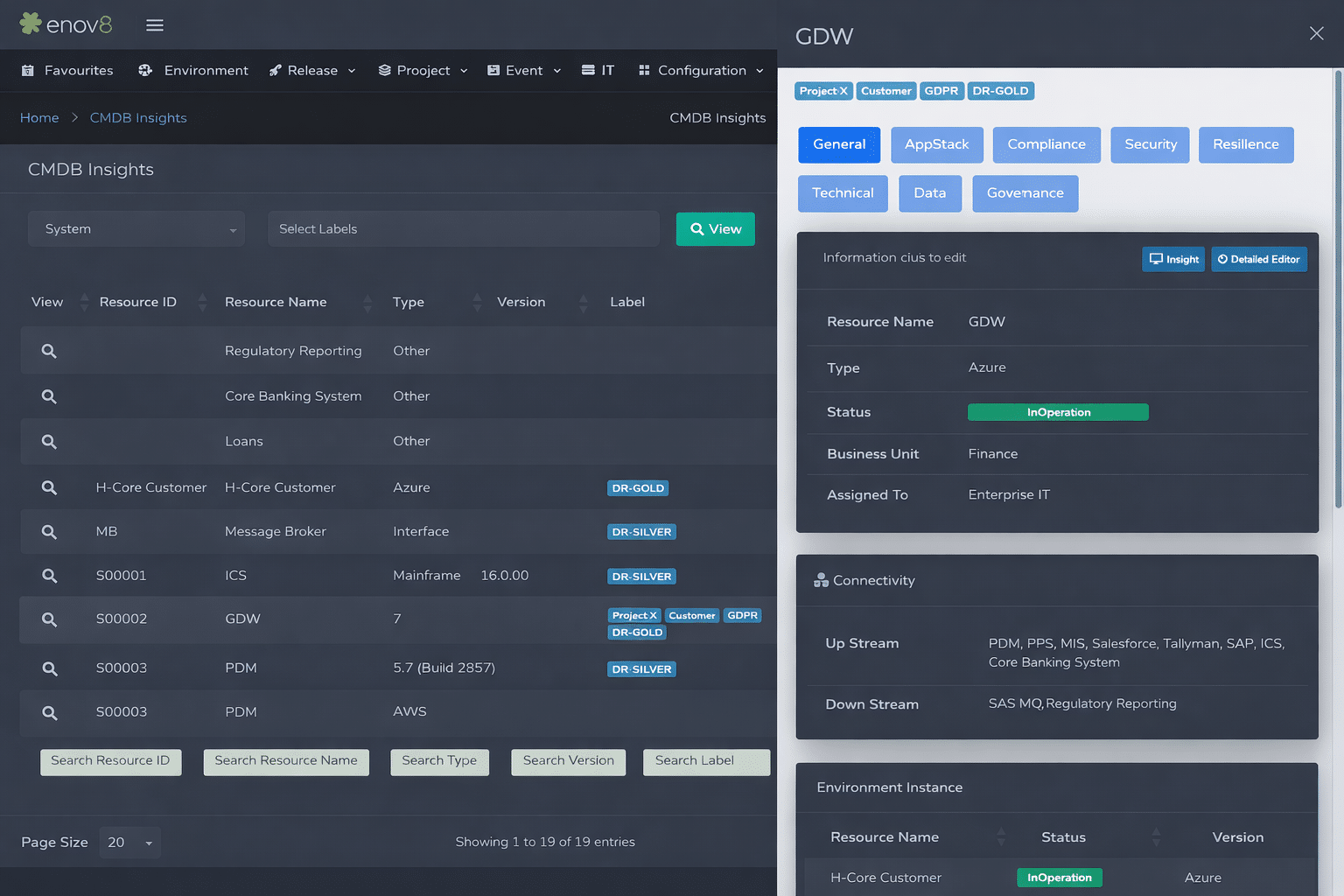
This solution is enabled by Enov8 Live Application Portfolio Management, part of the Enov8 enterprise platform for managing applications, environments, releases and data.
It provides the governed application knowledge needed to support rationalisation, architecture governance, lifecycle management, transformation planning and delivery alignment.
For organisations with existing systems of record, Enov8 can integrate with CMDBs, architecture repositories, project tools, cost systems, compliance platforms and delivery tools.
Related Solutions
Explore related Enov8 solutions that connect Applications, Environments, Release and Data across your landscape.
Frequently Asked Questions
What is Application Portfolio Management?
Application Portfolio Management is the discipline of maintaining a governed view of an organisation’s application estate. It captures application ownership, business purpose, dependencies, lifecycle status, cost, risk, compliance exposure, and strategic alignment.
Why is Application Portfolio Management important?
APM helps enterprises make better decisions about modernisation, rationalisation, cloud migration, compliance, cost reduction, and technology investment. Without it, major decisions are often based on incomplete or outdated information.
How is APM different from a CMDB?
A CMDB usually focuses on configuration items and operational relationships. APM focuses on the application portfolio from a business, lifecycle, cost, risk, and strategic planning perspective. Enov8 connects both views by linking application context to delivery execution.
How does APM support application rationalisation?
APM helps identify duplicate, redundant, underused, costly, or high risk applications. This gives organisations the evidence needed to consolidate, modernise, retire, or replace applications.
How does APM support cloud migration?
Cloud migration depends on understanding application dependencies, ownership, technical readiness, lifecycle status, and business criticality. APM provides the portfolio evidence needed to decide what should move, what should be retired, and what needs remediation.
How does Enov8 APM connect to delivery?
Enov8 connects application portfolio data to environments, releases, projects, test data, and delivery readiness. This means portfolio decisions are not isolated from execution.
Can Enov8 integrate with existing CMDB or architecture tools?
Yes. Enov8 can integrate with existing enterprise sources of truth, including CMDBs, architecture repositories, project tools, cost systems, compliance platforms, and delivery tools.
Who uses Application Portfolio Management?
APM is used by CIOs, enterprise architects, portfolio managers, application owners, transformation teams, risk teams, compliance teams, and senior delivery leaders.
Take Control of Your Application Landscape
Enterprise technology decisions depend on accurate application knowledge.
Enov8 Application Portfolio Management gives your organisation a live, governed, and connected view of the application estate, helping teams reduce risk, optimise cost, plan transformation, and connect strategy to delivery execution.