

Executive Summary
Microsoft Fabric is rapidly becoming a core platform for enterprise analytics and AI. As organisations increasingly use Microsoft Fabric to support artificial intelligence and machine learning initiatives, the importance of protecting sensitive data, managing PII, and meeting compliance obligations becomes critical.
AI initiatives rely on large volumes of realistic data. In many organisations, this data originates from production systems that contain personally identifiable information and other sensitive content. Using raw production data for AI introduces privacy risk, regulatory exposure, and long term governance challenges.
By integrating Enov8 with Microsoft Fabric, organisations can profile, mask, and validate data before it is consumed by AI workloads. This creates a governed data supply chain that delivers AI safe data while preserving analytical value and meeting compliance requirements.
Why AI Readiness in Microsoft Fabric Starts With Data
AI success begins with data readiness. Even the most advanced AI models cannot compensate for poor quality, poorly governed, or high risk data. In regulated industries, this challenge is magnified by strict privacy and compliance expectations.
Unlike traditional analytics, AI systems learn directly from data. Once a model has been trained, sensitive information may be embedded within the model itself. This makes data protection and compliance far more important for AI than for reporting or business intelligence use cases.
Microsoft Fabric provides powerful capabilities for data ingestion, engineering, analytics, and AI enablement. However, Fabric alone does not automatically identify sensitive data, classify PII, or enforce data masking policies. These controls must be deliberately introduced to prepare Fabric data for AI safely and at scale.
The Risk of Using Production Data and PII for AI
Many organisations continue to rely on production data for AI training and testing. While this data is rich and representative, it also carries the highest level of risk.
From a compliance perspective, regulations such as GDPR, HIPAA, APRA, and other regional and industry frameworks impose strict controls on how PII can be used. Training AI models on unprotected data may breach consent, purpose limitation, and data minimisation requirements.
There is also a material risk of data leakage. AI models trained on sensitive data may expose personal or confidential information through inference or model outputs. Once deployed, these risks are difficult to mitigate.
Bias and data quality issues further complicate AI outcomes. Without understanding data distributions and anomalies, AI models may reinforce historical bias or generate misleading insights.
Finally, unmanaged AI data pipelines weaken enterprise governance. Ad hoc masking and uncontrolled data copies undermine trust and auditability.
Data Profiling in Microsoft Fabric to Identify Sensitive Data
Before data can be masked or governed, it must be understood. Data profiling provides visibility into what data exists, where it resides, and how sensitive it is.
Profiling examines datasets to identify PII, confidential attributes, patterns, anomalies, and data quality issues. This replaces assumptions with evidence and provides the foundation for informed AI readiness decisions.
Without profiling, organisations often underestimate the volume of sensitive data in their Microsoft Fabric environments. Fields that appear non sensitive may contain personal identifiers, financial details, or regulated information.
Enov8 provides deep data profiling capabilities that integrate with Microsoft Fabric, enabling organisations to understand data risk before AI workloads are introduced.
Enov8 Data Profiling for Microsoft Fabric
Enov8 connects directly to Microsoft Fabric data sources and performs comprehensive profiling across structured and semi structured datasets. Data Profiling can be executed at scale and repeated consistently across environments.
Key capabilities include sensitive data discovery for PII, protected health information, payment data, and custom enterprise classifications. Enov8 also delivers structural and statistical analysis, including value distributions, pattern recognition, null analysis, and anomaly detection.
These insights are critical for AI initiatives. They ensure training data reflects realistic conditions while avoiding hidden compliance and privacy risk. Profiling results are captured and governed, creating a baseline for ongoing AI readiness and regulatory assurance.
Data Masking in Microsoft Fabric for AI and Compliance
Profiling identifies risk. Data masking mitigates it.
Data masking transforms sensitive data so it cannot be traced back to real individuals or entities, while preserving the characteristics required for analytics and AI. This is essential for protecting PII in AI training data.
Enov8 supports a range of data masking techniques suited to AI workloads. Deterministic masking preserves consistency across datasets, enabling joins and pattern learning. Format preserving masking ensures masked values retain original structure. Synthetic data generation can be used to replace highly sensitive fields where required.
Masking policies are centrally defined and applied consistently across Microsoft Fabric environments. This ensures repeatable outcomes and alignment with regulatory and organisational requirements.
Dynamic and Static Data Masking in Microsoft Fabric. Why Both Matter for AI
Microsoft Fabric provides native support for dynamic data masking and access controls. Dynamic masking restricts what users see at query time based on identity, role, or policy. This approach is effective for interactive analytics and reporting scenarios where data remains in its original form and access is tightly controlled.
Dynamic data masking is important, but it is not sufficient on its own for AI data readiness.
AI workloads differ fundamentally from traditional analytics. AI training jobs often run at scale, outside of interactive user contexts. Models learn directly from the underlying data and may retain patterns or values that are not visible through masked views. In these scenarios, relying solely on dynamic masking introduces risk.
Static data masking addresses this gap.
Static data masking creates a physically masked copy of the dataset where sensitive fields such as PII are permanently transformed or replaced. The masked dataset contains no real sensitive data and can be safely reused, moved between environments, and consumed by AI workloads without relying on runtime access controls.
Microsoft Fabric does not natively provide a governed static data masking capability. While Fabric enables powerful data engineering and security controls, it does not manage the lifecycle of statically masked datasets, including policy enforcement, validation, and auditability.
For AI data readiness, static data masking is essential. It ensures AI models are trained only on data that is intrinsically safe, compliant, and approved for reuse. Dynamic masking alone cannot guarantee this outcome.
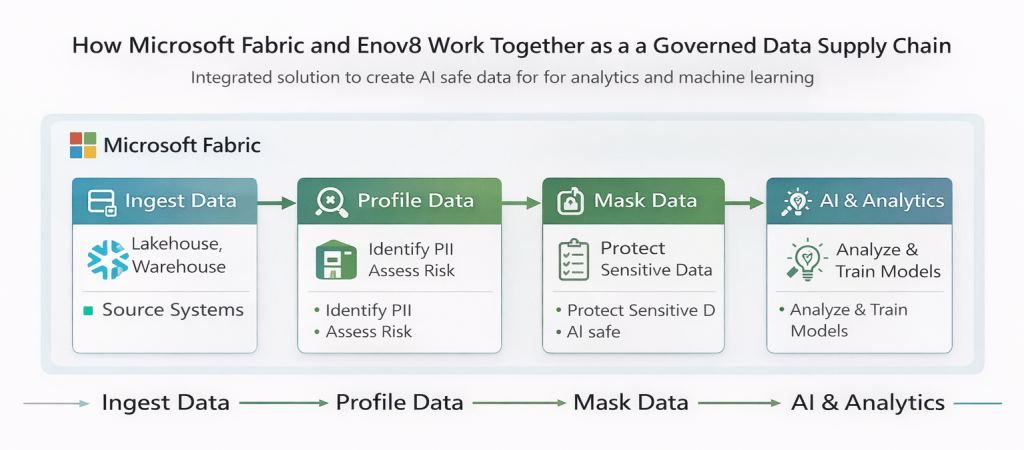
How Microsoft Fabric and Enov8 Work Together as a Governed Data Supply Chain
Preparing Microsoft Fabric for AI requires more than individual tools. It requires a governed data supply chain that ensures sensitive data is identified, protected, validated, and approved before it is used by AI workloads.
Microsoft Fabric provides the platform for data ingestion, transformation, analytics, and AI execution. Enov8 complements Fabric by enforcing governance controls across the data lifecycle, including data profiling, data masking, and validation.
Together, Fabric and Enov8 operate as a seamless data supply chain.
Data is ingested and engineered within Microsoft Fabric using Lakehouse, Warehouse, pipelines, or notebooks. Once data reaches a consumable state, Enov8 is invoked to profile the dataset, identify PII and sensitive attributes, and assess data quality characteristics relevant to AI.
Based on profiling results, Enov8 applies policy driven data masking to create a protected version of the dataset. The masked output is written back into Fabric, typically into a designated AI ready zone or workspace.
Before data is made available for AI training or experimentation, Enov8 performs validation checks to confirm that sensitive data has been adequately protected and that the dataset meets defined compliance and quality standards.
Only validated datasets are approved for AI consumption. This ensures AI models built on Microsoft Fabric are trained using data that is safe, compliant, and fit for purpose.
Governing PII and Compliance for AI in Fabric
AI initiatives must operate within established governance frameworks. Enov8 provides the controls required to support compliance, auditability, and repeatability.
Masking policies are centrally managed and aligned with regulatory obligations. Profiling, masking, and validation activities are fully auditable, providing traceability for internal governance and external compliance requirements.
This approach ensures consistency across development, testing, analytics, and AI environments. It also improves collaboration between data, security, compliance, and AI teams by providing a shared understanding of data risk and controls.
Governance becomes an enabler of AI rather than a barrier.
Business Outcomes of Preparing Microsoft Fabric for AI
Preparing Microsoft Fabric for AI using Enov8 delivers measurable business value.
AI initiatives progress faster because teams have timely access to realistic, compliant data. Privacy and regulatory risk is reduced by protecting PII before data reaches AI models. Trust in AI outcomes improves because models are trained on high quality, well understood datasets.
Organisations avoid the cost and inconsistency of manual data masking and fragmented governance processes. Compliance is strengthened without sacrificing agility or innovation.
Most importantly, AI becomes scalable, sustainable, and aligned with enterprise risk management.

Conclusion. Microsoft Fabric Ready for AI
Microsoft Fabric provides a powerful foundation for analytics and AI. However, AI success depends on more than platform capability.
AI requires data that is safe, compliant, and fit for purpose. Without visibility into sensitive data and effective data masking, AI initiatives introduce unacceptable privacy and compliance risk.
By using Enov8 TDM for data profiling, data masking, and validation, organisations can prepare Microsoft Fabric data for AI with confidence. PII is identified and protected, compliance requirements are met, and AI teams receive data they can trust.
Preparing Microsoft Fabric for AI is no longer optional. With Enov8, it is achievable at enterprise scale.