
We have all heard of the term Business Intelligence (BI), coined in 1865 (in the Cyclopaedia of Commercial and Business Anecdotes) and described more recently by Gartner as “an umbrella term that includes the applications, infrastructure and tools, and best practices that enable access to and analysis of information to improve and optimize decisions and performance”.
An area that has continued to evolve and even diverge into specific “industry” sectors such as Finance or Healthcare or specific operational sectors like sales and accounting.
With that in mind, and the growing importance of digital as the backbone of business, isn’t it time IT Departments had their own equivalent?
Here at Enov8, we think so, and in response, we developed our EcoSystem platform. Enov8 EcoSystem is the world’s first complete “Enterprise IT Intelligence” Solution.
Business Intelligence for your IT Organization
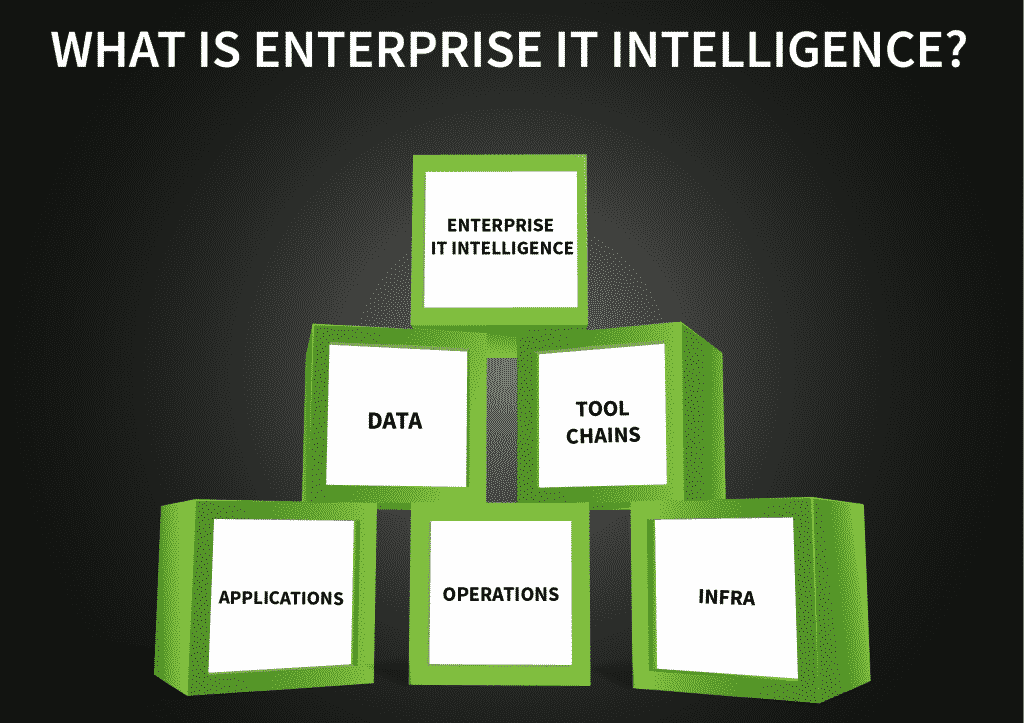
An umbrella platform that allows you to capture “holistic” real-time information across your IT Landscape (Environments, Data, Releases & Operations) with the intent of streamlined analysis, end-to-end insight, improved decision-making, and ultimately leading to better operations, orchestration, and continual optimization.

So, what is Enterprise IT Intelligence?
Well, like its overarching parent, Business Intelligence, “Enterprise IT Intelligence” is fundamentally the embracement of certain activities and the capture of key information that supports the management of your IT Delivery Lifecycle and your IT Solutions.
Key Activities:
- Information Discovery
- Information Aggregation (Mapping / Relating Data)
- Reporting & Dashboarding (Historical & Real-Time)
- Event Alerting & Notification
- Information Consolidation, i.e., Grouping, e.g., by Team, System or Function
- Measurement, e.g., Key Performance Indicators
- Prioritize (Identify Best Opportunities)
- Optimize (Collaboration / Act Upon the Data)
Key Success Factors:
There are three critical areas organizations should address before embarking on an “Enterprise IT Intelligence” Project.
- Ensure commitment from senior stakeholders, e.g., CIO, CFO & IT Executive Managers
- Identify the benefits of implementing such a solution. Think Cost, Agility, Stability & Quality.
- Understand where valuable information resides and understand data gaps.
Key Information
The following is a selection of information that you might want to consider as part of implementing an Enterprise IT Intelligence solution:
Your Data “Information Points”
- Think Data Sources, Databases, Grids, Structure, Content, PII Risks & Relationships
- Think People, e.g., Data Subject Matter Experts, DBAs & Data Scientists
- Think Data Delivery Operations like ETL, Fabrication & Security Masking
Your Applications “Information Points”
- Think Lifecycle Lanes, Systems, Instances, Components, Interfaces & Relationships
- Think People, e.g., Ent/Solution Architects, System Owners & Application Developers
- Think Application Delivery Operations like Design, Build, Release & Test
Your Infrastructure “Information Points”
- Think Servers, Clusters (Swarms), Cloud & Network (Firewalls, Routers & Load Balancers).
- Think People, e.g., Infrastructure, Network & Cloud Architects & Engineers Think Infrastructure Delivery Operations like Provision, Configure & Decommission
Your Tool Chain
- Project/Release Planning, Collaboration, Architecture Tools, Configuration Management, Version Control, Application Build, Continuous Integration, Packaging, Deployment, Infrastructure as Code, Data Integration/ETL, Test Management, Test Automation, Issue Tracking, IT Service Management, Logging & Monitoring.
Benefits of Enterprise IT Intelligence
The potential benefits of an Enterprise IT Intelligence platform include spotting problems early, trend behavioural analysis, accelerating and improving decision-making, optimizing internal IT processes, increasing operational efficiency (being agile at scale), driving IT cost optimization, and gaining a competitive advantage over your competition by providing better service and delivering solutions quicker.
Learn More
If you want to learn more about implementing Enterprise IT Intelligence, then speak to enov8 about our Ecosystem Solution. Enov8 EcoSystem is a complete platform that takes information from across the IT Spectrum and helps you better understand and manage your IT Fabric (Applications, Data, & Infrastructure), IT Operations & and orchestrate them effectively.

Coffee Time: More time for coffee. Here is some related reading: + Enterprise IT Intelligence & Orchestrating your Environments
About the Author | Niall Crawford. Niall is the Co-Founder and CIO of Enov8. He has 25 years of experience working across the IT industry, including Software Engineering, Architecture, IT & Test Environment Management, and Executive Leadership. Niall has worked with and advised many global organisations covering verticals like Banking, Defence, Telecom and Information Technology Services.