

Test data management (TDM) is a critical QA practice. It delivers reliable test datasets across environments.
However, in today’s fast-paced DevOps landscape, traditional TDM solutions are struggling to keep up with the demands of agile development and automated CI/CD pipelines.
For example, the need for rapid dataset delivery, privacy compliance, and scalability has outpaced the capabilities of legacy TDM practices.
Therefore, TDM needs a new approach, and that’s where Enov8 vME steps in.

The Limitations of Traditional TDM Solutions
Traditional TDM relies on ticket-driven models. Data consumers submit requests, and teams serve them one by one from a queue.
This antiquated process involves a complex data preparation phase, which includes mapping datasets to test requirements, searching for relevant entity objects recursively, applying subsetting algorithms for business process integrity, identifying and anonymizing sensitive data fields, and finally delivering the size-reduced database copies to the data-consuming teams.
Consequently, this elongated and intricate data preparation process poses several challenges:

1. Time-Consuming
As a result, most TDM tickets take days or weeks, and DevOps teams wait.
2. Complexity
In addition, complex data preparation slows delivery and makes refreshes harder.
3. Dependency on Central Teams
Traditional TDM also depends on DBAs and application SMEs, so it lacks self-service.
4. Storage Intensive
Furthermore, delivering multiple copies of databases results in increased storage footprint and significantly higher storage costs.
5. Fragility
Moreover, its reliance on precise mapping makes it fragile, so each change risks data quality issues.
6. Expensive
Likewise, the high-touch nature of the traditional TDM solution translates to increased operational costs in terms of headcount, tools, and storage.
7. Partial Test Coverage
Even with careful mapping, the datasets often represent production only partially, which creates quality risks.
The Modern DevOps TDM Alternative – Enov8 vME
In contrast, Enov8 vME offers the speed and flexibility DevOps demands.
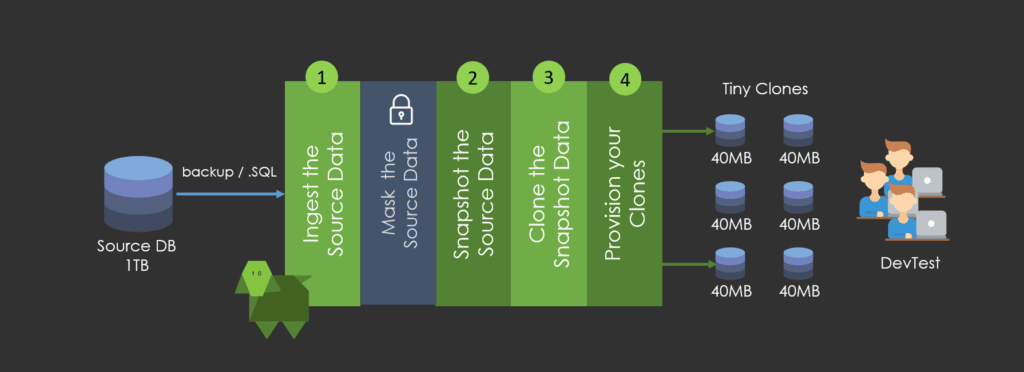
This innovative platform leverages virtual database technologies to create full read/write replicas of source databases in mere minutes, drastically reducing storage requirements.
In fact, the virtual databases function as efficient test datasets and eliminate the need for upfront data preparation or recursive entity searches.
With Enov8 vME, business processes no longer need to be meticulously mapped to datasets, and the time-consuming search for related entity records can be circumvented, as the entire database, complete with all record dependencies, is swiftly copied over.
As a result, all test cases get complete, accurate data with business process integrity intact.
Introducing Enov8 vME: Empowering DevOps Test Data Management
Also, Enov8 vME is designed to seamlessly integrate with the speed and agility of DevOps practices.
It offers a comprehensive TDM solution that provides ultimate control through APIs or self-service portals, enabling DevOps teams to continuously refresh, clone, version, and rewind datasets as needed and at scale.
Consequently, developers and QA teams run exhaustive tests without conflicts or delays.
Furthermore, Enov8 vME’s integrated data privacy search and masking capabilities ensure that all test data is free from sensitive information, meeting data privacy regulations and safeguarding against data breaches.
The platform’s compliance with data privacy standards adds an additional layer of security and confidence to the testing process.
Benefits of Enov8 vME’s Virtual Database-Powered TDM
Enov8 vME’s adoption of virtual database technologies revolutionizes TDM, offering a wide array of benefits compared to traditional approaches:
1. Fast Test Data Delivery
Enov8 vME facilitates swift delivery of virtual database copies, even for source databases that exceed terabytes of storage.
2. Privacy Compliance
By integrating sensitive data search with anonymization and masking algorithms provided through Enov8 TDM, Enov8 vME ensures that all test data remains free from private or sensitive information.
3. Self-Service Capability
As a result, developers, QA, and UAT teams no longer need to rely on centralized TDM teams or DBAs for test data delivery. Enov8 vME empowers users with self-service access to datasets through a user-friendly portal or API integration.
4. Storage Efficiency
Enov8 vME’s virtual databases are incredibly storage-efficient, resulting in reduced storage costs as more copies are created.
5. Stability
The adoption of full copies of source databases, coupled with the elimination of subset preparation, ensures a stable environment and reduces the risk of potential data quality issues.
6. Full Test Coverage
Because vME delivers full database copies, DevOps teams can access every record for complete test coverage.
7. Cost-Effectiveness
Overall, the combination of self-service capabilities and storage efficiency makes Enov8 vME the most cost-effective TDM solution available.
Enov8 vME, Workflow Overview
Conclusion
In conclusion, Enov8 vME revolutionizes Test Data Management for DevOps, breaking free from the constraints of traditional TDM practices.
By leveraging virtual database technologies, Enov8 vME empowers DevOps teams with swift, secure, and high-quality test data access, boosting innovation and accelerating software development.
So, embrace Enov8 vME for rapid, compliant, streamlined test data management.
Ultimately, Enov8 vME helps DevOps teams meet modern challenges with confidence.

Author Andrew Walker
Andrew Walker is a software architect with 10+ years of experience. Andrew is passionate about his craft, and he loves using his skills to design enterprise solutions for Enov8, in the areas of IT Environments, Release & Data Management.