
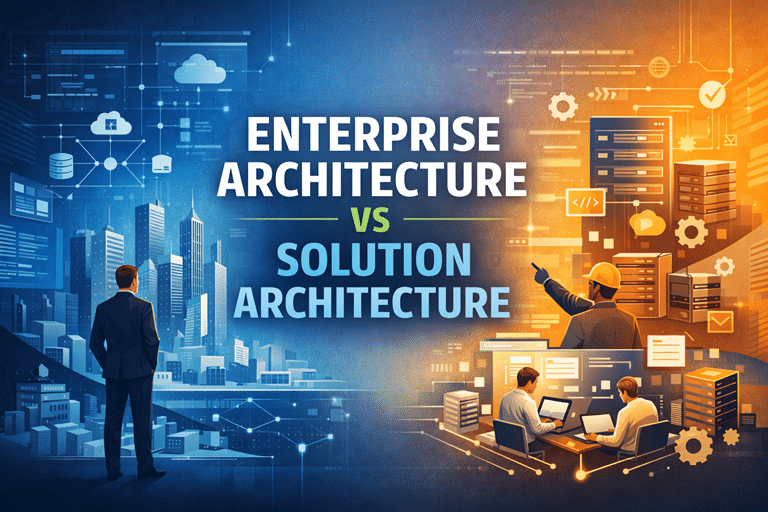
Modern organizations rely on complex technology ecosystems to support digital services, internal operations, and innovation. Designing and managing those ecosystems requires multiple layers of architectural planning.
Two of the most common disciplines involved are enterprise architecture and solution architecture. While the terms are sometimes used interchangeably, they represent different roles and responsibilities within an organization’s IT strategy.
Many organizations struggle to balance long-term IT strategy with project-level delivery. Without clear roles for enterprise and solution architecture, teams can waste resources, duplicate efforts, and encounter delays in implementing new systems. Understanding the difference helps organizations align technology decisions with business goals while enabling teams to design and deliver practical solutions.
In this guide, we’ll explain what enterprise architecture and solution architecture are, how they differ, and how they work together in modern enterprise environments.

What Is Enterprise Architecture?
Enterprise architecture (EA) provides a high-level blueprint for an organization’s technology ecosystem. It focuses on aligning technology capabilities with business strategy and ensuring that systems, processes, and platforms work cohesively across the enterprise.
Rather than concentrating on individual applications, enterprise architecture looks at the broader IT landscape. This includes applications, infrastructure, data platforms, integration patterns, and governance frameworks.
The purpose of enterprise architecture is to guide technology decisions in a way that supports long-term goals while maintaining consistency across systems and teams.
Key Responsibilities Of Enterprise Architects
Enterprise architects operate at a strategic level and are responsible for shaping the organization’s technology direction. Their work typically involves coordinating with executive leadership and IT governance teams to ensure technology investments support business priorities.
Common responsibilities include:
- Defining technology standards and architectural principles.
- Creating long-term technology roadmaps aligned with business strategy.
- Governing architecture decisions across departments and projects.
- Identifying opportunities to modernize or consolidate systems.
- Ensuring interoperability across applications and infrastructure.
Enterprise architects often work closely with CIOs, CTOs, and senior IT leadership, and they rely on robust data governance tools to enforce standards, manage risk, and maintain architectural consistency across systems.
Why Enterprise Architecture Matters
Large organizations often operate hundreds of interconnected systems. Without a clear strategy, environments can become fragmented and difficult to manage.
Enterprise architecture provides a framework for guiding technology decisions, evaluating new platforms, and maintaining consistency. It also supports long-term transformation initiatives by ensuring technology investments align with business objectives.
For instance, a multinational company may deploy different CRM systems across regions. Without an enterprise architecture framework, integrating these systems later can be costly, error-prone, and delay analytics or reporting initiatives. Enterprise architecture helps prevent these challenges by providing a unified approach to planning, standardization, and governance.

What Is Solution Architecture?
Solution architecture focuses on designing the technical architecture for a specific application, platform, or system. While enterprise architecture establishes the broader strategy, solution architecture addresses the practical design decisions required to deliver individual solutions.
Solution architects translate business requirements into technical designs that development teams can implement. Their work involves defining system components, selecting technologies, and ensuring that new solutions integrate effectively with existing systems.
In other words, enterprise architecture defines the strategic direction, while solution architecture determines how individual systems are built within that framework.
Key Responsibilities Of Solution Architects
Solution architects bridge the gap between business requirements and technical implementation. They collaborate with development teams, project managers, and enterprise architects to ensure solutions are technically sound and aligned with organizational standards.
Their responsibilities typically include:
- Designing system architecture for applications or platforms.
- Selecting technologies, frameworks, and integration patterns.
- Ensuring solutions meet performance, scalability, and security requirements.
- Supporting development teams during implementation and deployment.
- Ensuring new systems integrate smoothly with existing platforms.
Solution architects are involved throughout a solution’s lifecycle, from early design through implementation. They must also anticipate integration challenges and performance bottlenecks, particularly in organizations with legacy systems. Their role ensures that new systems operate reliably within the larger technology ecosystem.
Why Solution Architecture Matters
Even the best enterprise strategy can fail if individual systems are poorly implemented. Solution architecture ensures each new system is scalable, reliable, and integrates with the broader environment.
By translating architectural standards into practical designs, solution architects help organizations deliver systems that meet business needs while remaining consistent with enterprise strategies. They play a critical role in mitigating risks during deployment and ensuring that the system functions as intended from day one.
Enterprise Architecture vs Solution Architecture: Key Differences
Although both disciplines focus on designing technology systems, they operate at different levels.
The primary differences relate to scope, strategic focus, and the types of decisions each role makes.
1. Scope
Enterprise architecture addresses the entire technology landscape of an organization, considering how applications, infrastructure, data systems, and integration frameworks work together.
Solution architecture focuses on a specific system or project, designing and implementing a solution that fits within the broader environment. Enterprise architecture sets the overall direction, identifying technology patterns and standards that all systems should follow. Solution architecture takes these patterns and applies them to the design of a particular system, ensuring it can operate effectively within the broader IT landscape.
2. Strategic Vs Implementation Focus
Enterprise architecture is strategic, defining long-term technology direction, governance models, and standards.
Solution architecture is implementation-focused, translating strategy into concrete system designs that development teams can build.
3. Stakeholders And Decision Authority
Enterprise architects work with executive leadership, governance teams, and senior IT stakeholders, shaping strategy and setting standards.
Solution architects work closely with engineering teams, developers, and project managers, designing systems that meet business requirements while aligning with enterprise guidelines.
4. Time Horizon
Enterprise architecture focuses on long-term planning, with roadmaps spanning years.
Solution architecture operates within the lifecycle of a specific project or system.
Enterprise Architect Vs Solution Architect: Role Differences
Although closely related, enterprise architects and solution architects play distinct roles within an organization’s technology function.
Enterprise Architect
Enterprise architects shape the long-term structure of an organization’s technology ecosystem. They evaluate technology trends, define frameworks, and ensure investments support business strategy. Their influence often extends to digital transformation programs, cloud adoption, and platform modernization.
Solution Architect
Solution architects design the technical architecture for individual systems or platforms. They collaborate with developers to ensure systems are scalable, reliable, and consistent with enterprise standards, resolving technical challenges during implementation.
How Enterprise Architecture And Solution Architecture Work Together
Enterprise architecture sets the strategic direction, while solution architecture applies that strategy to specific systems.
Typically, enterprise architects define technology standards and preferred platforms. Solution architects design systems using those technologies while meeting project requirements. This collaboration ensures both strategic alignment and practical delivery.
For example, when adopting a cloud-based ERP system, enterprise architects define the overall cloud strategy and governance policies, while solution architects design the system’s modules, data flows, and integrations according to those standards. This approach ensures consistency and prevents costly rework during implementation.
Challenges When Enterprise And Solution Architecture Are Misaligned
When misaligned, organizations can encounter:
- Systems implemented without enterprise standards, causing fragmentation.
- Rigid governance processes that slow delivery.
- Poor visibility into system dependencies and environments.
- Architectural decisions failing to translate into operational processes.
Improved coordination and visibility can prevent these issues. Platforms like Enov8 help organizations visualize and manage complex environments, releases, and test data management.
Key Takeaways
Enterprise architecture and solution architecture are complementary disciplines. Enterprise architecture defines the strategic blueprint, while solution architecture designs and implements the systems that bring that strategy to life.
When both functions are clearly defined and coordinated, organizations can balance long-term planning with efficient system delivery, enabling innovation while maintaining a manageable technology landscape.
Gain Visibility Across Your Enterprise Architecture Landscape
Enterprise and solution architecture decisions only deliver value when executed reliably across environments, releases, and test data workflows.
Enov8 provides visibility and control across complex IT landscapes. Its solutions for environment, release, and test data management help teams manage dependencies, streamline delivery, and ensure architectural strategies are implemented effectively. A single view of these workflows also reduces risk, accelerates deployments, and maintains compliance.
Learn how Enov8 can help you improve operational visibility and accelerate enterprise delivery at scale.
