

In the landscape of modern business, where data sprawls across platforms and systems, maintaining a clear view and control over this vital asset is crucial. A data control tower (DCT) emerges as the beacon of control, offering a centralized system that orchestrates and manages data across an organization’s entire ecosystem.
What is a Data Control Tower: Quick Version
A data control tower is a centralized management layer that provides visibility, governance, and operational control over data as it moves across an organization’s systems, platforms, and environments.
Rather than storing or analyzing data itself, a data control tower coordinates how data is discovered, governed, protected, provisioned, and used, ensuring it is available to the right teams, at the right time, under the right controls.
At its core, a data control tower acts as an orchestration and oversight mechanism.
It connects disparate data sources, pipelines, environments, and cloud platforms into a unified control plane, allowing organizations to automate policies, enforce compliance, and monitor data usage end to end. This enables teams to manage complex data ecosystems proactively, rather than reacting to issues after they occur.
Unlike traditional data management tools that focus on isolated functions such as storage, analytics, or governance, a data control tower spans the full data lifecycle.
It bridges operational execution with governance and insight, supporting modern requirements such as multi-cloud architectures, rapid DevOps delivery, regulatory compliance, and secure access to production-like data for development and testing.
In doing so, a data control tower transforms data management from a fragmented set of tools into a coordinated, enterprise-wide capability.

Unlocking Data Potential with a Comprehensive Data Control Tower
In the intricate web of today’s business environment, where data flows through various channels and platforms, harnessing its potential requires more than just passive management. It demands a proactive approach, one that provides a unified view, streamlines processes, and ensures compliance and security.
This is where a data control tower steps in, offering a comprehensive solution to address the challenges of modern data management.
1. Centralized Data Management
At the heart of a DCT lies centralized data management, where disparate data sources converge into a single cohesive platform.
This integration not only simplifies access and visibility but also ensures consistency and accessibility across the organization. By breaking down silos and providing a unified interface, a DCT enables efficient management of data, irrespective of its source or location.
2. Automation and Compliance
Automation is the cornerstone of a DCT, driving efficiency and mitigating the risk of human errors. By automating processes such as data ingestion, synchronization, and transformation, organizations can accelerate operations while ensuring data quality and compliance.
Moreover, by enforcing data governance policies and regulatory standards, a DCT promotes a culture of accountability and transparency within the organization.
3. Enhancing DevOps and CI/CD
In the realm of DevOps and continuous integration/continuous delivery (CI/CD), speed and agility are paramount. A DCT facilitates this by providing on-demand access to test data, thereby accelerating development cycles without compromising security or compliance.
By efficiently managing and provisioning test data, teams can iterate faster and deliver high-quality products to market more rapidly.
4. Multi-Cloud Data Management
With the rise of multi-cloud strategies, managing data across disparate cloud environments poses a significant challenge. A DCT addresses this challenge by offering features such as data mesh libraries, which facilitate seamless synchronization and control of data across multiple clouds.
This ensures compliance with residency and sovereignty requirements while providing organizations with the flexibility to leverage the benefits of various cloud providers.
5. Data Privacy and Security
In an era marked by increasing data breaches and stringent data protection regulations, safeguarding sensitive data is paramount. A DCT enhances data security by centralizing data discovery and masking sensitive information before it is used in testing or development environments.
This proactive approach helps mitigate risks and maintain the integrity and confidentiality of data, thus safeguarding it against potential threats.
6. Data Governance
Central to effective data management is robust data governance. A DCT enables organizations to enforce data governance policies consistently across all data touchpoints, ensuring integrity, compliance, and adherence to best practices.
By providing visibility into data lineage, access controls, and usage patterns, a DCT fosters a culture of accountability and transparency within the organization.

How a Data Control Tower Works
A data control tower operates as an orchestration and oversight layer that sits above an organization’s existing data systems rather than replacing them. Its role is not to store data or perform analytics directly, but to coordinate how data is accessed, governed, provisioned, and monitored across the enterprise.
At a practical level, a data control tower integrates with source systems, data pipelines, environments, and platforms to create a unified control plane. Through this control plane, organizations define policies for data usage, security, and compliance, then automate their enforcement across the data lifecycle.
This ensures consistent behavior regardless of where data resides or which teams are interacting with it.
A key aspect of how a data control tower works is the separation between execution and control. Execution continues to happen in the underlying systems such as databases, cloud platforms, and CI/CD pipelines, while the control tower provides centralized visibility, coordination, and governance.
This separation allows organizations to scale and modernize their data architectures without losing oversight or introducing manual bottlenecks.
By combining integration, automation, and visibility, a data control tower enables organizations to manage complex, distributed data ecosystems proactively. Teams gain confidence that data is being handled correctly by design, rather than relying on downstream checks or reactive remediation when issues arise.
Data Analytics & Insights
With data aggregated in one centralized platform, a DCT unlocks the power of analytics, enabling organizations to derive valuable insights from their data assets.
By leveraging advanced analytics tools and techniques, stakeholders gain deeper insights into operations, customer behavior, and market trends, empowering data-driven decision-making and strategic planning.
Enhanced Decision Support
Timely and informed decision-making is critical.
A DCT acts as a catalyst for decision support, providing stakeholders with timely access to relevant data and insights. By facilitating data-driven decision-making processes, organizations can respond swiftly to market changes, mitigate risks, and capitalize on opportunities, thereby gaining a competitive edge.
Key Benefits of a Data Control Tower
1. Reduced Operational and Compliance Risk
A data control tower reduces operational and regulatory risk by centralizing policy enforcement and automating governance controls across the data lifecycle. This minimizes the chances of sensitive data exposure, inconsistent handling, or noncompliance, particularly in complex, multi-cloud and regulated environments.
2. Faster Delivery Without Losing Control
By streamlining data access, provisioning, and oversight, a data control tower enables teams to move quickly through development, testing, and deployment cycles without compromising governance or security. This allows organizations to balance speed and control without relying on manual approvals or fragmented tooling.
3. Improved Data Trust and Auditability
A data control tower provides end-to-end visibility into data lineage, access, and usage. This transparency helps teams understand where data originates, how it is used, and whether it complies with internal and external requirements, supporting audits, troubleshooting, and confident data reuse.
4. Greater Executive Visibility and Decision Confidence
With a unified view of data operations and governance, a data control tower gives leaders clearer insight into risk, performance, and priorities across the enterprise. This enables faster, more informed decision-making and positions data as a strategic asset rather than a source of uncertainty.
Enov8 as Your Data Control Tower
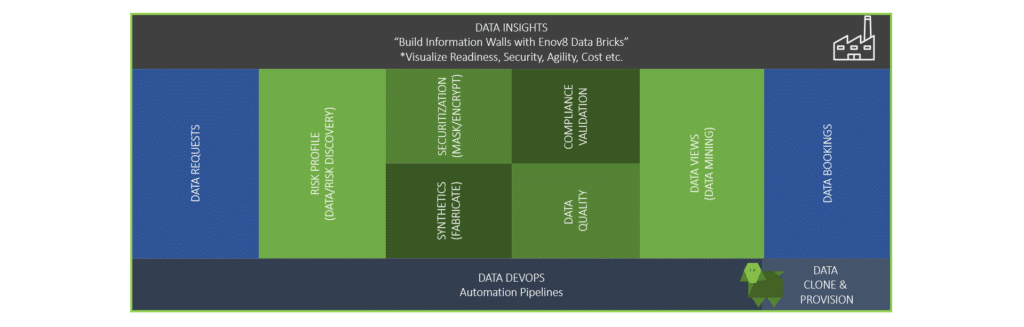
Enov8 delivers the capabilities of a data control tower by unifying control, governance, and operational visibility across complex data ecosystems. Rather than addressing data challenges in isolation, Enov8 provides an integrated platform that enables organizations to manage data safely, efficiently, and at scale.
By combining test data management, environment virtualization, and enterprise governance, Enov8 supports end-to-end oversight of how data is accessed, provisioned, protected, and used throughout the software delivery lifecycle.
Enov8 Test Data Management (TDM)
Enov8 Test Data Management provides the foundation for safe and compliant data usage by enabling profiling, masking, validation, and synthetic data generation. These capabilities allow organizations to deliver high-quality, production-like data to development and testing teams while protecting sensitive information.
As part of a data control tower, TDM ensures data trust, consistency, and regulatory compliance without slowing delivery.
Enov8 vME (Virtualization & Environment Management)
Enov8 vME enables rapid data ingestion, database virtualization, and environment provisioning across development, testing, and training workflows.
By abstracting and virtualizing complex data environments, vME reduces the time and effort required to manage infrastructure while maintaining centralized control. This supports faster delivery cycles while preserving governance and operational oversight.
Enov8 Platform
The Enov8 Platform serves as the governance and insight layer of the data control tower. It provides visibility into data lineage, usage, and performance, enabling organizations to enforce policies consistently and monitor compliance across teams and systems.
With centralized insight and control, stakeholders gain the clarity needed to manage risk, optimize operations, and make informed decisions.
Conclusion
In the realm of data control towers, Enov8 offers a holistic approach to data management, governance, and insight.
By leveraging Enov8 Test Data Management for profiling, masking, validation, and synthetics, Enov8 vME for database virtualization, rapid ingestion, and provisioning, and the Enov8 Platform for governance and insight capabilities, organizations can unlock the true potential of their data assets.
With Enov8 as your DCT, the journey towards comprehensive data management and control reaches new heights, enabling organizations to thrive in today’s data-driven world.

Post Author
Jane Temov is a Senior Consultant at Enov8, where she specializes in products related to IT and Test Environment Management, Enterprise Release Management, and Test Data Management. Outside of her professional work, Jane enjoys spending her time walking her dogs along the Sydney coastline.