
How enov8 can help you achieve true DevOps
SEPTEMBER, 2017
by Rohit Gupta
Key Benefits of DevOps
- Faster Software Release
- Quick Issue Resolution
- Improved Communication and collaboration
- Faster delivery of features
- Early Detection and faster correction of defects
- Quality Improvement
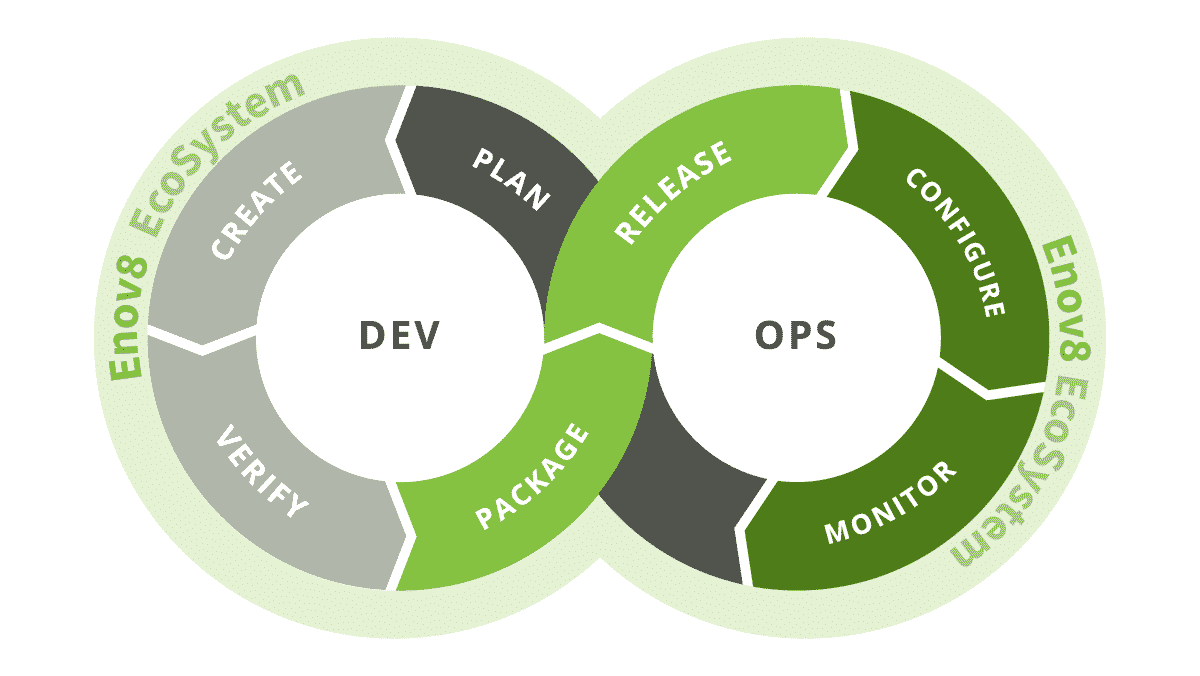
Organisations these days are jumping into DevOps bandwagon, with multiple toolsets being used by different teams to achieve the same. There is a huge investment being made in getting new tools & training and at the same time no focus is being given on the use of existing toolset.
Enov8 ecosystem is a unique solution for Environment & Release Management which acts as an umbrella on your existing IT framework and helps in leveraging the existing or new tools to achieve true DevOps at Scale function.
It helps organisations with this by providing the following unique features.
Understanding your environment landscape
The ecosystem platform helps the organisation to visualize how their IT environments look like and the dependencies within each components. It also enables users to understand the dependencies application components have on business process and services. This allows the teams to proactively plan their DevOps setup and measures to manage risks in case of failures.
Increasing Demand View
Ecosystem helps organisations to capture the demand for their various components. This helps them to forecast the areas which can be targeted as high priority for automation, to reduce manual efforts of release and deployment. This view also helps in pro-actively planning and co-ordinating DevOps activities.
Automation & Orchestration
Automation is the heart of achieving the DevOps dream. Ecosystem using automation helps in standardizing Build, Deploy and Test activities, while promoting existing application automation toolsets. It can help in invoking pre-defined automation tasks as per requirements. It also helps organisation to understand which tasks are being done manually and can be automated to reduce time and effort.
Integration
Ecosystem has strong integration and API capabilities which can be used to invoke and integrate with existing or 3rd party applications. Ecosystem acts as an umbrella on top of these applications to leverage the right capabilities. It also helps in standardizing configuration, provisioning & decommissioning activities while promoting existing infrastructure toolsets through seamless integration.
Dashboards & Reporting
Ecosystem helps in moving away from manual spreadsheets, emails and other makeshift methods for reporting, allowing for effective reporting on activity, behaviour, usage & availability. It has inbuilt dashboards and a reporting engine which allows vizualisation of data from different perspectives. Dashboards can be created for stakeholders to provide them a high-level view of the progress or status. Simultaneously, application teams can use dashboards to collaborate and communicate with other teams instead of wasting time writing reports and emails.
Effective Collaboration
Successful team collaboration is one of the key factors for effective DevOps practice. Ecosystem enables teams to collaborate with each other by providing them a platform which gives them visibility of key information required for effective decision making and operations.
To learn how enov8 can help you implementing DevOps at Scale and standardizing your operations, contact us for a demonstration today.
Relevant Articles
MongoDB Clone Database Explained
Every engineering team relies on MongoDB cloning, but very few do it safely at scale. What starts as a simple way to copy data often turns into security risks, rising costs, and inconsistent environments. Cloning a MongoDB database is used to create safe,...

Data Anonymization Tools: 9 to Know About in 2026
A common risk in modern software delivery is using copies of production data for development and testing. These environments rely on realistic datasets but often include sensitive customer, financial, or health data that should not leave production systems. Data...

Postgres Data Masking: A Guide to Securing PostgreSQL Test Data
PostgreSQL stores sensitive data such as customer profiles, financial transactions, and authentication records. This data is often copied into lower environments for development, testing, and analytics. The issue is that these environments aren’t designed to safely...

Data Poisoning vs. Poor Data Preparation: The Enterprise AI Risk Comparison
There is a pattern that repeats itself whenever a new technology becomes strategically important to the enterprise. First, adoption outpaces understanding. Then, when something goes wrong — a breach, a failure, a scandal — the industry scrambles to retrofit governance...

PII Risk in AI Is an Architecture Problem
AI is moving rapidly from experimentation into enterprise scale. Use cases are expanding, agents are emerging, and data is being pushed into pipelines at increasing speed. At the same time, organisations are trying to keep up with the associated risk. The response is...

What Is Enterprise Architecture Governance? A Complete Guide
Enterprise architecture rarely fails because of bad technology. It fails because of too many good decisions made in isolation. Modern enterprises operate across cloud platforms, SaaS tools, legacy systems, APIs, and data environments that evolve independently. This...