

Release management, an integral part of the larger Product Lifecycle Management (PLM) process, refers to the process of planning, coordinating, and controlling the deployment of software changes into production environments.
It involves the coordination of different stakeholders and the use of various tools and techniques to ensure that software releases are delivered efficiently, effectively, and with minimal risk.
In today’s digital age, software has become an integral part of businesses, and software releases have become more frequent and complex. For large enterprises, managing software releases can be a daunting task that requires a comprehensive strategy and a team of experts.
Release management is critical for large enterprises as it helps them to manage the complexity of software releases, reduce the risk of failures and downtime, and ensure that software releases meet the needs of the business.

In this post, we will explore the benefits of release management for large enterprises, including the importance of the release-centric approach, governance, maintaining business and IT alignment, and release risk management.
A Release Centric Approach
Release management at the enterprise scale involves managing the release life cycle as a project with defined goals, timelines, and outcomes.
This approach helps large enterprises to efficiently manage software releases, reduce the risk of failures and downtime, and ensure that software releases align with business goals.
Focusing on the release life cycle helps large enterprises identify bottlenecks and inefficiencies in the release process, improve collaboration and communication between teams, and ensure high-quality software releases that meet business needs.
Enterprise Release Management (ERM) platforms provide end-to-end visibility and control over the entire release process, from planning to deployment.
These tools enable enterprises to identify and mitigate risks, improve collaboration and communication between teams, and accelerate software delivery.
In large enterprises, value streams can comprise multiple release trains, and release trains may consist of multiple value streams. As the number of software applications and delivery accelerates, the risks to releases and the enterprise overall increase.
These risks include noncompliance with regulations, security standards, or other governance requirements, release scheduling conflicts, and missing the right features at the right time.
ERM platforms are crucial for mitigating these risks. They allow release managers and other stakeholders to view the application portfolio as a system, provide traceable data for compliance auditing, and offer analytics that alert users of scheduling and timing risks.
Consistent governance compliance is achieved by using scalable and repeatable release templates across an enterprise portfolio to ensure governance requirements are consistently followed.
ERM platforms enable system-wide scheduling, allowing release managers, PMO, and product managers to plan releases accurately at the enterprise level, taking into account interdependencies, resource requirements, and timing of each release.

Common Release Management Challenges at Enterprise Scale
Even with a release-centric approach in place, large enterprises run into recurring obstacles. Applications rarely exist in isolation, and the complexity only grows as more systems, environments, and teams become involved.
1. Complex Application Dependencies
A single release can affect systems and teams that weren’t part of the original planning. Without clear visibility into these dependencies, organizations risk missed handoffs, conflicting changes, and last-minute surprises during deployment.
2. Inconsistent Environments and Deployment Processes
Environments spanning multiple clouds or data centers often rely on different tooling, configurations, and deployment procedures. These inconsistencies make releases harder to coordinate and increase the risk of delays or failures.
3. Siloed Teams and Limited Visibility
Teams working in silos may release changes without fully understanding how their work intersects with other applications or value streams. This can lead to scheduling conflicts, competing priorities, and unexpected downstream impacts.
ERM platforms help address these challenges by mapping dependencies across the portfolio and giving every team a shared view of what’s releasing, when, and how it connects to everything else.
Governance
Governance is an essential aspect of release management in large enterprises. It ensures that software releases are aligned with business goals, comply with regulatory requirements and security standards, and are consistent across different teams and departments.
Enterprise Release Management (ERM) platforms play a critical role in enforcing governance policies. They provide a centralized platform for release managers and stakeholders to define, enforce, and audit governance policies across the entire release process.
ERM platforms enable the standardization of release processes, ensuring that governance policies are consistently followed across different teams and applications. This helps to reduce the risk of non-compliance, which can result in fines, loss of customer trust, and reputational damage.
ERM platforms also enable the traceability of release activities, allowing organizations to demonstrate compliance with regulatory requirements and security standards. This is especially important in highly regulated industries such as healthcare and finance.
Furthermore, ERM platforms provide visibility into the release process, allowing stakeholders to identify potential governance risks and take corrective actions in a timely manner.
This includes identifying scheduling conflicts, ensuring the availability of required resources, and ensuring that all necessary approvals are obtained before a release is deployed.
Maintaining business and IT alignment
Business and IT alignment is crucial for the success of any enterprise. In order to maintain alignment, it is important to establish and maintain clear communication channels between the business and IT teams.
This involves understanding the business objectives and aligning IT initiatives to meet those objectives.
One effective approach to maintaining alignment is to use a collaborative approach to develop and prioritize IT initiatives. This involves engaging both business and IT stakeholders in the process to ensure that IT initiatives are aligned with business goals, priorities, and timelines.
By involving both teams in the decision-making process, it becomes easier to ensure that everyone is on the same page and working towards the same objectives.
Regular meetings between the business and IT teams are also important to maintain alignment. These meetings should focus on discussing progress towards objectives, reviewing IT initiatives, and identifying any potential roadblocks or issues that may arise.
This helps to ensure that everyone is aware of what is happening within the organization and is working towards the same goals.
Another important aspect of maintaining alignment is to ensure that IT initiatives are regularly reviewed and updated to ensure that they continue to meet the needs of the business.
This involves regular monitoring of IT initiatives to ensure that they are on track and making adjustments as necessary to ensure that they are meeting business objectives.
Overall, maintaining business and IT alignment requires a collaborative approach, clear communication, and a commitment to regularly review and update IT initiatives to ensure that they continue to meet the needs of the business.
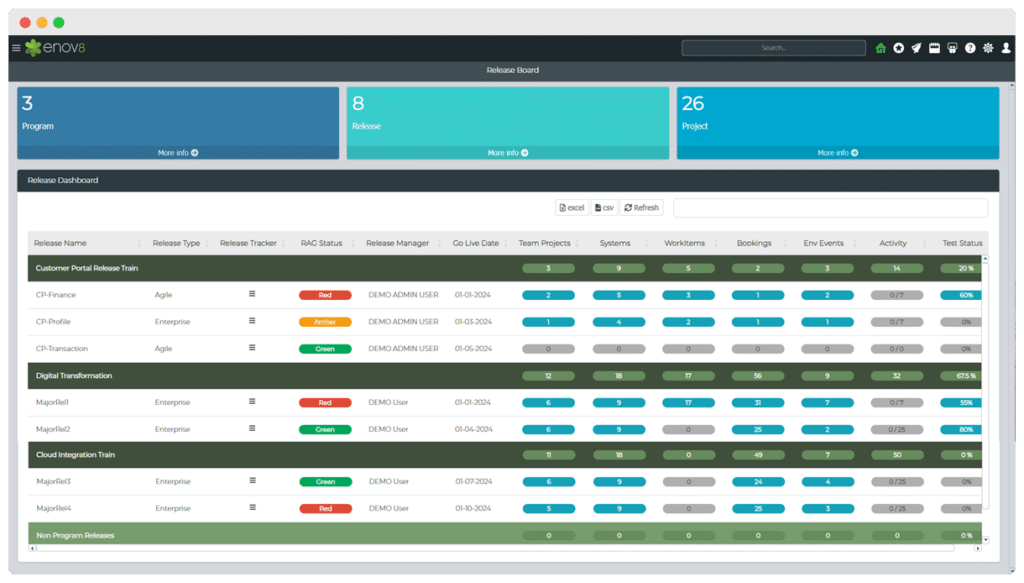
Enov8 Enterprise Release Manager, Release Planning: Screenshot
Release Risk Management
Effective management of release risk is crucial for enterprises to avoid security vulnerabilities, non-compliance, and other issues that can lead to fines, loss of customer trust, and additional work to bring applications back into compliance.
As enterprises continue to accelerate their software delivery, the risks associated with releases and the enterprise overall increase.
To mitigate these risks, Enterprise Release Management (ERM) platforms play a critical role.
These platforms provide release managers and other stakeholders with a system-wide view of the application portfolio, allowing for traceable data to ensure compliance auditing and analytics to alert users of scheduling and timing risks.
Consistent governance compliance can be achieved by using scalable and repeatable release templates across an enterprise portfolio to ensure that governance requirements are consistently followed.
Traceable data of release activities allows for release audits to verify compliance.
ERM platforms also allow release managers, PMOs, and product managers to understand how to accurately plan releases at the enterprise level, taking into account the interdependencies, resource requirements, and timing of each release.
Another crucial aspect of release management in mitigating risks is scoping. Release managers need to constantly balance IT work and business needs.
ERM platforms allow release managers to easily increase or decrease the scope of a release to meet release timelines. Teams upstream and downstream can see the current release scope and timing to ensure that everyone is on the same page and the risk of release failure is controlled.
Measuring Release Management Success
Reducing risk is easier to sustain when it’s backed by data. Enterprises that track release performance typically monitor a small set of core metrics: deployment frequency, lead time for changes, change failure rate, and mean time to recovery (MTTR). Together, these numbers show not just whether releases are happening, but whether they’re happening safely and predictably.
ERM platforms make these metrics easier to capture consistently across teams, since release activity is already being logged in one system rather than scattered across individual tools. Reviewing these KPIs regularly helps release managers spot slowdowns or recurring failure points early, turning release management from a one-time risk check into an ongoing improvement process.
Conclusion
After considering the benefits of release management for large enterprises, it is clear that having a comprehensive Enterprise Release Management (ERM) platform is crucial for success.
The Enov8 Enterprise Release Manager is an excellent option for companies looking for a solution that allows release managers and other stakeholders to see the application portfolio as a system, provide traceable data for compliance auditing, and analytics that alert users of scheduling and timing risks.
The platform enables consistent governance compliance, system-wide scheduling, and scoping, which can help enterprises mitigate risks associated with the release process.
In summary, implementing a release-centric approach with the help of an ERM platform like Enov8 Enterprise Release Manager can provide numerous benefits for large enterprises, such as increased efficiency, reduced risk of failures and downtime, and alignment of software releases with business goals.
It is a wise investment that can help organizations stay competitive in the fast-paced software industry.
Other ERM Reading
Some more Release Management articles you can read over a coffee:
Enov8 Blog: Release Management Explained in Depth
Enov8 Blog: What is Release Management in ITIL – A Guide and Best Practice

Author Andrew Staples
Andrew Walker is a software architect with 10+ years of experience. Andrew is passionate about his craft, and he loves using his skills to design enterprise solutions for Enov8, in the areas of IT Environments, Release & Data Management.